
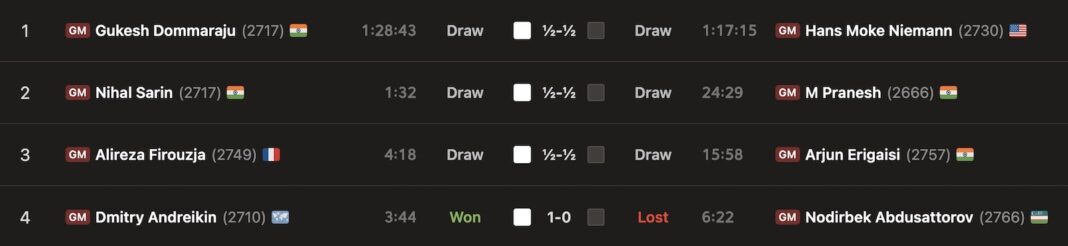

GM Alireza Firouzja has taken clear first place in the 2026 Quantbox Chennai Grand Masters after making a draw with GM Arjun Erigaisi in the final round. GM Nodirbek Abdusattorov could have forced a playoff with a win, but instead he overpressed and lost to GM Dmitry Andreikin, who edged second place on tiebreaks. World Champion Gukesh Dommaraju preserved his 2700 status by sacrificing a bishop to make a quick draw against GM Hans Niemann, but both players overlooked that Niemann could have played on. GM Nihal Sarin vs. GM Pranesh M was the day’s other draw, with both players finishing on 50 percent.
Andreikin scored his first win of the 2026 Chennai Grand Masters in the final round.
Firouzja finished half a point clear of Andreikin and Arjun, with Andreikin having the better tiebreaks. Gukesh finished a point adrift in last place, but avoided the worse fate of dropping out of the 2700 club—he ended on 2703.1.
Final Standings


There were two big storylines on the final day of the Chennai Grand Masters. Of course the main one was who would win the title, but we got an answer to the other one first—would Gukesh stay in the 2700 club?
Gukesh Avoids Dropping Out Of The 2700 Club
It’s only four years since Gukesh barged his way into the 2700 club, while a year later, at 17, he beat GM Magnus Carlsen’s record as the youngest player to cross 2750. In the run-up to the 2024 world championship match, Gukesh reached 2794, and when he won the title it seemed as though the only question was whether he’d go on to cross 2800 or become world number-one. It’s stunning, therefore, that we’re where we are now.
Gukesh is still only 20, so that fluctuations are no surprise, but the slump since defeating GM Ding Liren has been shocking. Going into the final round in Chennai, Gukesh had lost three games and won none in his home supertournament, and was one loss away from falling out of the 2700 club. By way of comparison, Carlsen crossed 2800 at the age of 18 and has never fallen below that mark in the intervening 17 years.
In the end, Gukesh made a quick draw in the final round and limited the rating loss to 13.9 points, so that although he ended in last place he at least stayed in the 2700 club, on 2703.1 on the live rating list.

In some ways it was a performance that didn’t reflect Gukesh’s play—he’d been completely winning against Arjun and Pranesh and, if he’d pushed his h-pawn one square instead of two, might have survived a tricky endgame against Firouzja—but, on the other hand, the final round could also have ended in disaster!
On move 12 of a known position seen in over 100 high-level games, Gukesh thought for six minutes and went for a novelty—sacrificing his bishop on h6.

The computer screams blunder and indicates capturing the knight, but, after thinking for nine minutes, Niemann took the bishop immediately and the game hurtled toward a 19-move draw.
Niemann had in fact seen the computer’s top line, but he commented: “I saw everything, but I don’t think I believed that I could have received such a ridiculous gift! It’s very rare you are just winning out of the opening with Black against the world champion, so perhaps I should have been more optimistic, but it was just a very weird game.”
I saw everything, but I don’t think I believed that I could have received such a ridiculous gift!
—Hans Niemann
Black wouldn’t be completely winning in the best line, but Gukesh would have been under immense pressure with his 2700 club status on the line. Niemann claimed being the one to demote the world champion wasn’t a motivation for him: “I really don’t care. My job is to win chess games and it doesn’t matter who I play—I’m indifferent.”

Niemann avoided last place but ended winless, with some missed chances to look back on. For Gukesh, it’s another event to forget in a hurry, and poses some questions for India’s Olympiad captain. Gukesh was the absolute star in Budapest in 2024, scoring 9/10 for a 3056-performance individual gold on board one, but where will he play in Samarkand in September? Could he even be left out?
When Niemann was asked why Ding and Gukesh had struggled so much after winning the title, he responded, “They were never the best players in the world, so it’s not a major shock.”
They were never the best players in the world, so it’s not a major shock.
—Niemann on Ding and Gukesh struggling after winning the world championship
Don’t be surprised, however, if Gukesh storms back in the near future to get back to where we assumed he belongs.
Meanwhile, after that early action, the battle for first place continued elsewhere, with all the remaining games stretching to full length.
Firouzja Claims Title As Abdusattorov Falls To Andreikin
Firouzja ultimately eased to victory on his debut in the Chennai Grand Masters, and put it down to his fast start: “I think after I won the first two games I had a comfortable lead and didn’t take as much risk.”

The French star entered the final round knowing a draw would at least guarantee him a playoff for the title, while Arjun needed to win on demand with the black pieces. Arjun went for the Sicilian Defense, but Firouzja opted for the solid Alapin with 2.c3, and while Arjun did a good job of prolonging the game he never came close to winning a very drawish endgame.

That left Abdusattorov as the only player still able to catch Firouzja and force a playoff, but the Uzbek star’s hopes of claiming the title were smashed against the rock of Andreikin, who had drawn his previous six games. Abdusattorov had Black and never got real chances for the win he needed, while after 27…Nf6? 28.Nc5! he was losing.

Abdusattorov would get one more chance to escape, but in the end Andreikin went on to score a deserved win and take second place in a rare supertournament appearance.
That’s our Game of the Day, which GM Rafael Leitao analyzes below.


It was a tough finish for Abdusattorov, who dropped from fifth to eighth on the live ratings with that loss, and, more significantly, missed out on any FIDE Circuit points.

Firouzja’s win, meanwhile, earned 24.915 Circuit points and should take him up to seventh place in that race for a 2028 FIDE Candidates spot. Arjun moves up to sixth, despite the disappointment of only tying for second place again in Chennai.
Abdusattorov finished level on 50 percent with Nihal and Pranesh, who played out a largely uneventful draw. Both could be satisfied with suffering only a single loss in Chennai, since they also picked up big wins. Nihal took down Arjun, while Pranesh has the bragging rights of beating the world champion.

That’s all for this year’s Chennai Grand Masters—we hope you enjoyed the show!
How To Rewatch
The fourth edition of the Quantbox Chennai Grand Masters took place July 16-22, 2026, in Chennai, India. The event was an eight-player round-robin, with 90 minutes for all moves, plus a 30-second increment from move 1. The top prize was ₹25,00,000, which is around $26,000.