
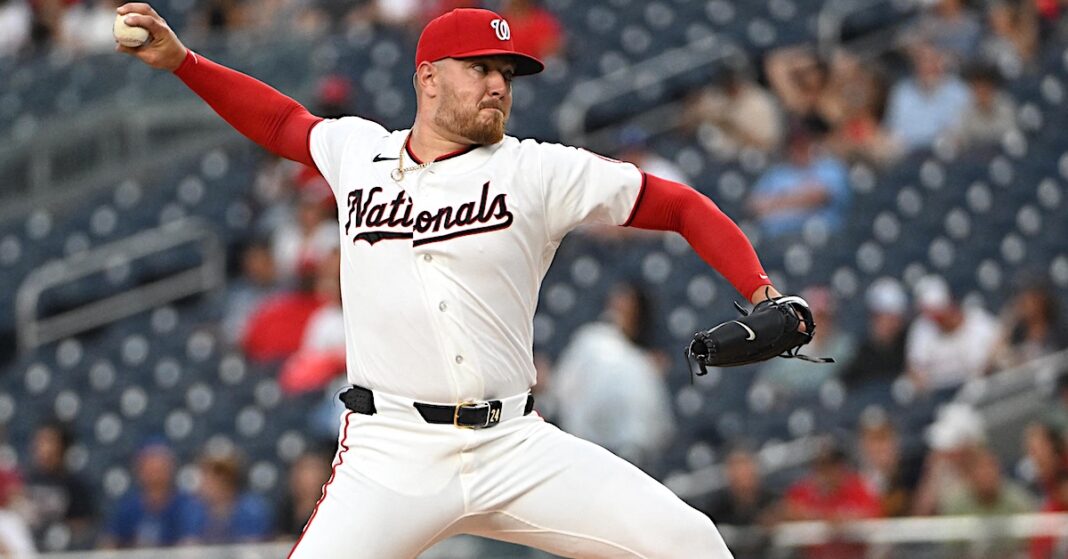

The Nationals have been one of my favorite teams to watch this season. Their offense has been spectacular, the best in the majors in multiple statistical categories. They’re scoring 5.48 runs per game, which easily paces the league. Even better for my viewing purposes, they rarely play a dull game. That’s because their pitching staff allows nearly as many runs as their offense scores. They’ve allowed the third-most runs in the majors this year, an ugly 5.21 per game.
This combination of amazing hitting and questionable pitching has given the Nationals their best shot at making the playoffs since they won the World Series in 2019. It also makes their goals at the trade deadline simple: Get more pitching. But before the Nats decide who to acquire, they need to figure out who to replace. That means the question I’ve been wondering in recent months is also surely of great interest to the DC decision-makers. That question: Is Cade Cavalli this good?
The majority of the Washington rotation is easy for me to evaluate. Foster Griffin? Pretty good! He came back from a three-year stint with the Yomiuri Giants this winter, and the six-pitch mix he developed there has served him well. Nothing he throws will wow you, but he has good command of it all and uses everything well. Sure, he’s not as good as his 2.76 ERA, but pretty much every other ERA estimator has him in the mid-to-high threes. The Nats, again, are allowing more than five runs a game. He’s an outlier relative to the rest of the pitching staff.
The bottom of the rotation? It’s undeniably ugly. Miles Mikolas did the return-from-NPB-and-excel act himself, but that was nearly a decade ago now, and the sooner Washington can get him out of the rotation, the better. When you have a higher ERA (5.65) than K/9 (4.59), that tells you all you need to know. Likewise, Zack Littell had a delightful run as a converted reliever with the Rays, but reality has hit him hard this year. His 5.17 ERA is actually the best of his run prevention estimators. He’s allowed an unfathomable 25 home runs in 101 innings, and the Nationals have increasingly deployed him following an opener to limit the damage. Their fifth starter is a revolving door; Andrew Alvarez, a 12th-round pick in 2021, has been chipping in off and on this month, but he just got sent to the minors after his latest start.
There are reinforcements on the way. Connelly Early, recently acquired from the Red Sox in trade, is set to start a rehab assignment next week. Jake Irvin has already started his own rehab (though his career 5.00 FIP and 4.96 ERA imply that he might not be that much of a solution). Trevor Williams is technically close to a return as well, although the four homers he gave up in his own latest rehab start suggest the Nats should probably keep looking for upgrades. Josiah Gray might return this year, but he also might not. Add all that up, and you get about one starting rotation spot that can be covered by players returning from injury.
That just leaves Cavalli, who’s having easily the best season of his career after a long saga of injuries held him back. A 2020 draftee, he debuted in the majors in 2022, but didn’t graduate from prospect status until 2025. If Cavalli is as good as his 2026 form (3.58 ERA, 3.12 FIP, plenty of juicy peripherals), the Washington rotation is fixable at the deadline. Acquire one playoff-worthy fourth starter at a steep price, grab a fifth-starter type, and you can see the outlines of a playoff team here. (Let’s not talk about the bullpen today.) If Cavalli is more of a third or fourth starter, though, the equation doesn’t work so well.
You Aren’t a FanGraphs Member
It looks like you aren’t yet a FanGraphs Member (or aren’t logged in). We aren’t mad, just disappointed.
We get it. You want to read this article. But before we let you get back to it, we’d like to point out a few of the good reasons why you should become a Member.
1. Ad Free viewing! We won’t bug you with this ad, or any other.
2. Unlimited articles! Non-Members only get to read 10 free articles a month. Members never get cut off.
3. Dark mode and Classic mode!
4. Custom player page dashboards! Choose the player cards you want, in the order you want them.
5. One-click data exports! Export our projections and leaderboards for your personal projects.
6. Remove the photos on the home page! (Honestly, this doesn’t sound so great to us, but some people wanted it, and we like to give our Members what they want.)
7. Even more Steamer projections! We have handedness, percentile, and context neutral projections available for Members only.
8. Get FanGraphs Walk-Off, a customized year end review! Find out exactly how you used FanGraphs this year, and how that compares to other Members. Don’t be a victim of FOMO.
9. A weekly mailbag column, exclusively for Members.
10. Help support FanGraphs and our entire staff! Our Members provide us with critical resources to improve the site and deliver new features!
We hope you’ll consider a Membership today, for yourself or as a gift! And we realize this has been an awfully long sales pitch, so we’ve also removed all the other ads in this article. We didn’t want to overdo it.
The easiest way for me to think about this is by starting with a first-level evaluation and moving up. That first level is pretty easy. Cavalli was a top prospect. His scouting report the year he debuted had him as a 55-FV prospect, and the FanGraphs team was hardly alone in that view. He flashed four plus pitches, and while his command was a work in progress, he looked like the kind of tall, strong, prototypical ace starter that teams covet. How can you be surprised that a guy we graded as having a 70 fastball and three 60 secondaries is making people look silly in the majors? If anything, we should be surprised it took so long.
That level has a clear counterpoint: Most pitching prospects don’t pan out. In 2022, we gave 10 pitchers a FV grade of 55 or higher. Those 10 have produced only three individual seasons worth three or more WAR (one by Hunter Greene, two by George Kirby). If Cavalli eclipses the 3-WAR plateau this year, as we project him to do, he’ll actually be one of the most successful pitchers of his class despite missing most of 2023 and 2024 with injury. Between injury and ineffectiveness, the attrition rate for top pitching prospects is simply astronomical.
The next level of looking into Cavalli is that he’s dominating guys right now. You can’t fake a 3.12 FIP with peripherals to match. Strikeout rates above 25% don’t grow on trees. If a pitcher has a line like Cavalli’s, you don’t even need to look any further. He’s good right now, so he’ll be good in a month. End of story.
I think this is a pretty good argument, truthfully. I’m not sure I buy Cavalli’s 3.12 FIP, but I don’t have to. I can look at the individual building blocks and extrapolate. For example, does Cavalli’s roughly league-average swinging strike rate mean he’s an ace? Not at all. But it does tie him with Griffin for the best mark in the current Nats rotation. (Alvarez has a SwStr% one-tenth of a percentage point higher, but in a third of the innings, and he’s back in the minors.)
Likewise, Cavalli walks fewer batters than average and gets more grounders than average. Do those statistics mean he’s automatically elite? Clearly not. But it probably means he’s not terrible. In fact, only 20 pitchers in baseball this year fulfill three fairly simple criteria that I set: 70 or more innings pitched, 8% or lower walk rate, and 45% or higher groundball rate. Cavalli clears these bars comfortably – 116 2/3 innings, 7.1% walk rate, 48% groundball rate. That cohort has been phenomenally effective this year. The only outright bad pitcher in the group is Brayan Bello, and his 17% strikeout rate and meatball-lobbing ways don’t look like what we’re seeing from Cavalli. The average ERA for people who merely keep the ball on the ground and avoid walks? That would be 3.28, with a 3.40 FIP, a 3.32 xFIP, a 3.65 xERA – you get the idea.
Let’s play devil’s advocate, though. Sure, Cavalli’s in that group now, but this is the first season in which he’s hit even 50 innings. It’s not like his past track record is all that useful in forecasting his future. But there’s a pretty obvious reason for his high groundball rate, at the very least. Cavalli’s best pitches these days are probably his breaking balls. He’s always thrown a hard, two-plane curveball that generates tons of grounders, but he’s added a new variation on the pitch this year.
His “sweeper” moves at almost the same speed as his curveball, with extra horizontal movement. There aren’t many sweepers with similar movement. The only pitcher who gets more downward vertical break on his sweeper is Dylan Cease. That’s the kind of comparison I love to see; it’s a lot easier to assess an outlier pitch when it looks a lot like a great pitcher’s best offering. The only other pitch in the same general vicinity of velocity and induced movement is Bryce Miller’s sweeper, and again, yes please, sign me up for these comparisons.
Cavalli only uses his sweeper against righties, which makes sense; against lefties, he prefers to stick with his curveball. But both pitches break downward so much that batters hit them into the ground at a huge clip, at least when they aren’t swinging over them. The two account for about 40% of his offerings against both lefties and righties, just with slightly different mixes. In other words, Cavalli’s getting all these grounders because he throws a lot of pitches that induce grounders. It’s not some weird fluke; it’s just a natural consequence of his offerings.
We can go up another level, though. Sure, Cavalli is getting to his success by keeping the ball on the ground with his secondaries. But can he keep doing that? This is the toughest call of the bunch. I keep turning over one thing in my head: His fastball just doesn’t play, and that makes it hard to forecast his future.
Cavalli’s fastball was a lot of the appeal in his prospect profile. He still throws quite hard, even after all the injury issues; he tops out near 100 mph and sits in the 96-97 band consistently. But raw velocity isn’t enough, and the rest of the pitch’s characteristics are somewhere between ordinary and bad. Movement-wise, it sits right in the dead zone. He gets less backspin and less arm-side fade than your average hard fastball, and since he releases it from a roughly average arm angle with roughly average extension, there’s just no bat-missing or contact-suppressing juice.
As of yet, there doesn’t appear to be much control juice there either. This is a tough thing to measure, because it’s impossible to prove intent, but there are certainly some troubling signs in Cavalli’s data. He leaves his fastball over the heart of the plate more than league average, but hits the corners less than league average. PitchingBot thinks he throws more meatballs – pitches that the model assigns a 3% or higher chance of being hit out of the park – than league average. Our two pitching models both think that his fastball is below average overall. The results, as measured by run value, have been poor. This isn’t a particularly difficult pattern to follow.
Where does that leave us? In a state of uncertainty, just like the Nationals. The truth is that we just don’t know whether Cavalli is going to turn his confusing profile into sustainable success. He has some good pitches. He has some bad pitches. He’s still working on a profile that will maximize his talents. It’s certainly working right now – but we’ve been robbed of a lot of opportunities to evaluate Cavalli because of all the missed time.
I don’t think this makes the deadline impossible to navigate for the Nationals, though. They have no choice but to look at Cavalli as likely to make it work. He’s succeeding right now, and the truth is, it’s impractical for Washington to assemble an entire starting rotation without Cavalli in it. Sure, he might turn into a pumpkin or get hurt. But that’s true of anyone the team would be adding to the rotation, and I think that Cavalli’s upside is higher. So while I couldn’t answer the question of whether he will be good in the long run, I do feel comfortable saying that from a decision-making standpoint, it just doesn’t matter all that much. The Nationals should go out and trade for some pitching at the deadline – whether or not their former top-prospect pitcher continues the excellent run he’s on.