
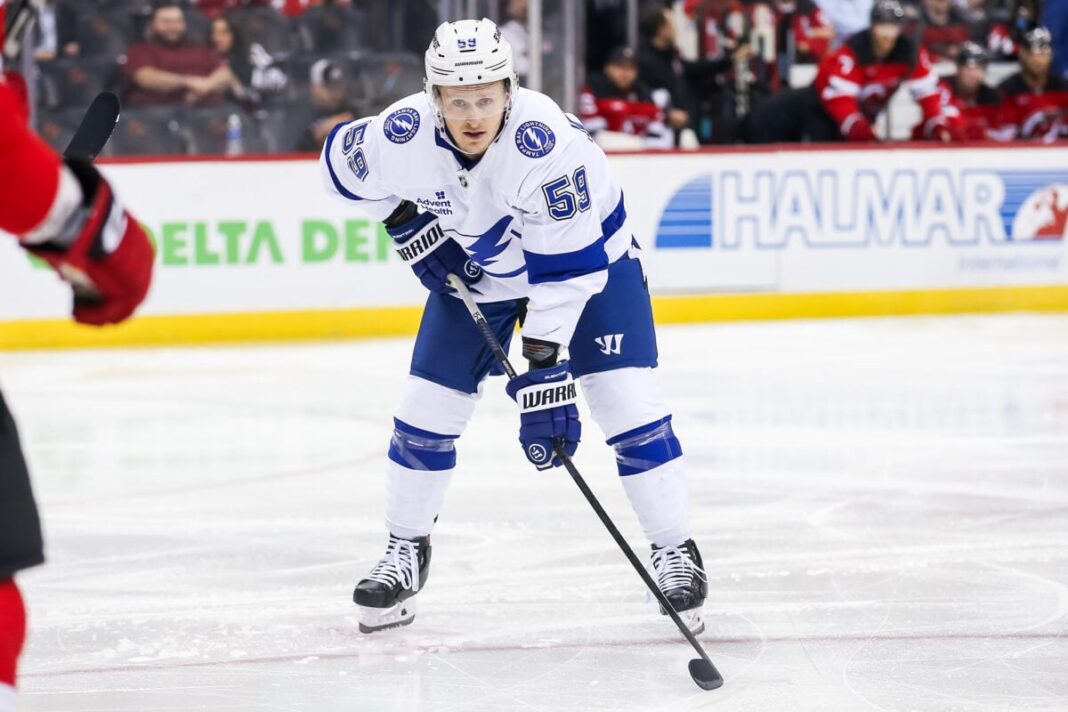

The Pittsburgh Penguins traded Jake Guentzel and Ty Smith to the Carolina Hurricanes in March 2024 for Michael Bunting, prospects Ville Koivunen, Vasily Ponomarev, and Cruz Lucius, plus conditional first- and fifth-round draft picks.
Carolina did not reach the 2024 Stanley Cup Final, so the conditional first-rounder became a second-round selection. Pittsburgh used that pick to draft Harrison Brunicke 44th overall. The fifth-round pick did not transfer because the Hurricanes failed to win the Stanley Cup.
That entire return is approaching another important checkpoint.
Lucius informed the Penguins that he would not sign an entry-level contract and can become an unrestricted free agent (UFA) on Aug. 15. Pittsburgh has known about his decision for months, but its significance is increasing as the deadline approaches and other teams begin viewing him as one of the more attractive college players entering the market.
Lucius is not Pittsburgh’s best prospect, and his departure will not destroy the Guentzel return. It will remove another original piece from a trade built around turning one elite winger into several opportunities.
That strategy can still produce value. The margin for error is becoming smaller.
Lucius’ Final College Season Raised the Stakes
Losing Lucius would have been less significant one year ago. His first season at Arizona State was disrupted by injury, limiting him to two goals and 10 points in 19 games. He remained a skilled forward with offensive potential, but there was no guarantee he would develop into a meaningful prospect. His senior season changed that evaluation.
Lucius recorded 15 goals and 31 assists in 36 games, establishing NCAA career highs in every major offensive category. His 46 points were the second-highest single-season total in Arizona State history, and his 1.28 points per game ranked second in the NCAA.
The Sun Devils’ season summary also showed that he played every game, surpassed 100 career NCAA points and finished first in the conference in assists and points. That production does not guarantee Lucius will become an NHL player. College free agents regularly attract attention without developing into permanent roster pieces. It does not make his departure any easier.
Lucius is leaving after providing the strongest offensive season of his career. Pittsburgh will not receive a compensatory draft pick or another prospect when his rights expire. A player who appeared to be gaining value within the Guentzel return is ready to walk.
A New Jersey Devils report examining four possible NCAA free agents identified Lucius as a potential target because of his production and offensive projection, which shows his name is beginning to reenter the discussion as Aug. 15 approaches.
Guentzel Return Was Built on Multiple Chances
The Penguins were never going to replace Guentzel with one player. The official trade announcement made the front office’s strategy clear. Pittsburgh accepted one established NHL forward, three prospects and conditional draft capital instead of securing one obvious premium asset. That made quantity the foundation of the return.
The Penguins did not need Bunting, Koivunen, Ponomarev, Lucius and both draft conditions to reach their best possible outcomes. They needed enough of those pieces to develop, retain value or create additional assets.
THW’s original Guentzel trade breakdown reflected the gamble immediately. Pittsburgh traded a proven first-line scorer without receiving a clear blue-chip prospect in return.
Bunting provided NHL value before becoming part of another branch of the trade tree. Pittsburgh sent Bunting and a 2026 fourth-round pick to the Nashville Predators for Tommy Novak and Luke Schenn. The official Bunting trade announcement confirmed that Novak was under contract through 2026-27, giving Pittsburgh a younger center with additional team control.
The Penguins then moved Schenn to the Winnipeg Jets for a 2026 second-round pick and a 2027 fourth-round selection. Pittsburgh used the second-rounder to select Markus Ruck 39th overall in June.
That leaves Novak, Ruck, and the additional 2027 fourth-round pick as Bunting’s extended value within the trade.
The secondary return matters. It prevents the Guentzel deal from being judged only by the three prospects Carolina originally sent to Pittsburgh.
The original prospect portion is still shrinking.
Penguins Have Already Lost Ponomarev’s Path
Lucius is not the first prospect from the return whose path with Pittsburgh has effectively ended.
Ponomarev spent the 2024-25 season with the Wilkes-Barre/Scranton Penguins before signing a three-year contract with Avangard Omsk of the Kontinental Hockey League (KHL).
Pittsburgh retained his rights at the time by extending him a qualifying offer. The organization’s 2025 free-agency update confirmed that Ponomarev had committed to the KHL after arriving as one of the more professional-ready prospects in the Guentzel package.
Signing in Russia did not immediately make Ponomarev a lost asset. Prospects return to Europe for playing time, development opportunities and contract considerations. Pittsburgh still controlled his NHL rights and could have revisited the relationship later.
The three-year commitment moved him outside the organization’s immediate plans. His status became more significant when he was not among the seven restricted free agents Pittsburgh qualified in June 2026.
Lucius’ situation is different because the Penguins wanted to sign him immediately after his college career. The result is similar.
Two of the three prospects acquired directly from Carolina will no longer provide Pittsburgh with immediate developmental value. Ponomarev is committed to the KHL, while Lucius is preparing to choose another NHL organization.
Koivunen Needs to Become a Defined NHL Player
That leaves Koivunen as the only original prospect still actively competing for a future with the Penguins. He has always been the most important prospect in the Guentzel return.
He established himself as one of Pittsburgh’s best young forwards during his first full season in North America, recording 21 goals and 56 points in 63 American Hockey League games. He then added seven assists during an eight-game NHL opportunity at the end of 2024-25.
The next step was less convincing. Koivunen made Pittsburgh’s opening-night roster last season but did not hold a permanent spot. He moved between the NHL and AHL, producing two goals and five assists in 39 games with the Penguins while continuing to score at a much higher rate with Wilkes-Barre/Scranton.
That gap is why Pittsburgh still needs a real plan for him.

His vision and offensive awareness remain useful. Koivunen can identify passing lanes, support possession and find open areas when the play slows down. The NHL requires him to create those same advantages with less time and space.
Lucius’ departure does not change Koivunen’s skill set or development timeline. It changes how much of the original trade’s prospect value now rests on his progress.
Pittsburgh does not need Koivunen to become another Guentzel. That would be an unrealistic standard for a player Carolina selected in the second round. The Penguins need him to become a reliable NHL forward.
A permanent top-nine role would give Pittsburgh a young player capable of contributing through the franchise’s transition. Even a consistent middle-six role would carry value for an organization trying to become younger without completely abandoning its veteran core.
Another season divided between Pittsburgh and Wilkes-Barre/Scranton would make the evaluation more difficult.
Dubas has added Egor Chinakhov, Nicholas Robertson, Hendrix Lapierre, and Andrei Kuzmenko while retaining several veteran forwards. Ben Kindel, Rutger McGroarty and other prospects are also competing for opportunities.
Koivunen has more competition than he did when Pittsburgh acquired him.
That makes training camp one of the most important stretches of his development. He must show that his hockey sense can translate into enough pace, strength and production to claim a role rather than wait for one.
Brunicke Carries the Return’s Highest Upside
Harrison Brunicke was not sent to Pittsburgh as a drafted player, but he has become one of the most important pieces connected to the Guentzel trade.
The Penguins used the conditional selection from Carolina to take Brunicke 44th overall in 2024. He has since developed into one of the organization’s best defensive prospects.
Brunicke earned a place on Pittsburgh’s opening-night roster as a 19-year-old last season. He scored one goal in nine NHL appearances, recorded four assists during a five-game AHL stint and represented Canada at the World Junior Championship before returning to the Kamloops Blazers in the Western Hockey League.
His official season development review highlighted how unusual the year became. Brunicke moved between the NHL, AHL, junior hockey and international competition before joining Wilkes-Barre/Scranton for its playoff run. That experience gives him a stronger foundation entering 2026-27.
His size, skating and right-shot value provide a legitimate path toward Pittsburgh’s blue line. He does not have to make the NHL roster immediately, but he needs to continue showing that his ceiling extends beyond organizational depth.
The recent Penguins’ top 15 prospects ranking placed Brunicke among the most important young players in the system. That status now carries additional weight.
If Brunicke develops into a top-four defenseman, Pittsburgh will have secured a valuable long-term piece with the main draft selection from the Guentzel deal. If Koivunen also becomes a regular NHL forward, the original trade could produce two young contributors alongside the value created through Bunting.
If both stall, the return becomes much harder to defend.
Lucius’ Departure Narrows the Margin
The Penguins do not have to regret trading Guentzel simply because Lucius intends to sign elsewhere.
Guentzel was approaching UFA status, Pittsburgh was moving away from playoff contention and the organization needed younger assets. Holding him through the deadline and potentially losing him for nothing would have carried its own cost.
The trade should still be evaluated honestly. Guentzel was an elite winger with proven chemistry beside Sidney Crosby. Pittsburgh accepted a package without one obvious blue-chip prospect because Dubas believed several assets could collectively provide enough long-term value.
Some of that value remains. Novak is an NHL forward. Ruck is a recent second-round selection. Pittsburgh still owns the additional 2027 fourth-round pick acquired through Schenn. Koivunen remains a talented forward prospect, and Brunicke may have the highest ceiling of any individual piece connected to the deal.
Lucius’ approaching free agency removes another possibility. His final Arizona State season explains why the loss matters. Pittsburgh is not walking away from a prospect whose development had stalled. It is losing a player immediately after the best season of his career.
That does not mean Lucius will punish the Penguins by succeeding elsewhere. His next organization must still determine whether his skating, pace, and offensive production can translate to professional hockey. Pittsburgh will no longer control that evaluation.
The Guentzel trade was designed to create several paths toward value. Ponomarev’s path has moved to the KHL. Lucius’ path is about to continue with another organization. Koivunen and Brunicke now carry more of the burden.
They do not have to replace Guentzel individually. They need to become meaningful enough NHL players to prove Pittsburgh received more than temporary depth and a collection of secondary assets.
Lucius reaching free agency will not deliver the final judgment on the trade, but it will make the remaining judgment much clearer.
Free Newsletter
Get Pittsburgh Penguins coverage delivered to your inbox
In-depth analysis, breaking news, and insider takes – free.
Subscribe Free →