
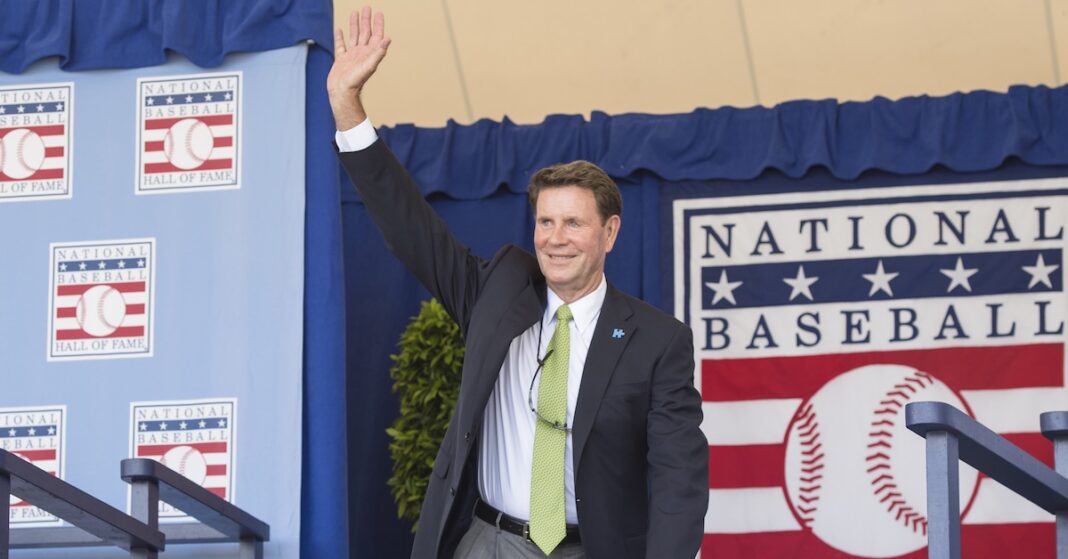

Jim Palmer faced 870 different hitters over the course of a Hall of Fame career that spanned from 1965 to 1984. A Baltimore Oriole throughout, the now-80-year-old broadcast analyst did so while fashioning a 268-152 won-lost record and a 2.68 ERA. A six-time All-Star who captured three Cy Young Awards, he is widely considered the best pitcher in franchise history.
How well does Palmer remember his matchups against Carl Yastrzemski, Rod Carew, and other notables from his era? Moreover, can he correctly answer questions such as “Who did you strike out the most times?” and “Who did you surrender the most home runs to?” I decided to find out. Given his reputation as an entertaining storyteller with a good memory, Palmer seemed like a perfect fit for our Challenging Career Quiz series.
That he didn’t know who he had faced the most times came as a surprise. Palmer faced Yastrzemski a whopping 197 times, with his next most frequent matchup, Graig Nettles, lagging well behind with 160. Of course, his not being able to name the Red Sox icon didn’t mean there weren’t stories. With Palmer, there are almost always going to be stories.
“I came up on April 17, 1965,” recalled Palmer. “I had played in A-ball, then went to instructional ball, and they decided to keep me. They’d expanded the roster to 28, and I was in the bullpen. I was rooming with Robin Roberts, who was 38 years old and had 270 wins. I was 19 and didn’t have any.
“We got five runs off of [Bill] Monbouquette in the first inning, then they got three off of Robin,” Palmer continued. “He got in more trouble in the third, and they told me to get up. I started throwing, then came in. Hank Bauer was our manager. He said, ‘Are you nervous?’ I said, ‘Well, I’ve never done this before,’ because I hadn’t pitched in the big leagues, nor had I ever relieved. Anyway, I walked Yastrzemski [to load the bases] to get to Tony Conigliaro, who was the best young hitter in the American League. He was the best young high-fastball hitter. I never allowed a grand slam in 3,948 innings, but I could have done it there against Conigliaro. He swung at two high fastballs, then I accidentally threw one low and away that the home plate umpire called a strike. But that was the first time I faced Yaz.”
Palmer went on to say that Yastrzemski — 41-for-169 with four round-trippers when facing him — once hit a home run against him that ended up not counting, as the game was rained out before becoming official. He also said that until late in Yaz’s career, the fellow Cooperstown inductee had tremendous bat speed and that it was hard to beat him even with your best fastball.
You Aren’t a FanGraphs Member
It looks like you aren’t yet a FanGraphs Member (or aren’t logged in). We aren’t mad, just disappointed.
We get it. You want to read this article. But before we let you get back to it, we’d like to point out a few of the good reasons why you should become a Member.
1. Ad Free viewing! We won’t bug you with this ad, or any other.
2. Unlimited articles! Non-Members only get to read 10 free articles a month. Members never get cut off.
3. Dark mode and Classic mode!
4. Custom player page dashboards! Choose the player cards you want, in the order you want them.
5. One-click data exports! Export our projections and leaderboards for your personal projects.
6. Remove the photos on the home page! (Honestly, this doesn’t sound so great to us, but some people wanted it, and we like to give our Members what they want.)
7. Even more Steamer projections! We have handedness, percentile, and context neutral projections available for Members only.
8. Get FanGraphs Walk-Off, a customized year end review! Find out exactly how you used FanGraphs this year, and how that compares to other Members. Don’t be a victim of FOMO.
9. A weekly mailbag column, exclusively for Members.
10. Help support FanGraphs and our entire staff! Our Members provide us with critical resources to improve the site and deliver new features!
We hope you’ll consider a Membership today, for yourself or as a gift! And we realize this has been an awfully long sales pitch, so we’ve also removed all the other ads in this article. We didn’t want to overdo it.
Who homered against him the most times is a two-way tie between Jim Rice and a slugging third baseman who spent the bulk of his career with the New York Yankees. Each went yard nine times, and Palmer named them with no hesitation.
“Nettles and Rice,” he stated. “I saw Jim yesterday and reminded him that eight of them were solos. I told him, ‘I felt sorry for you, so I let you get some solo home runs. You were just a kid from South Carolina and didn’t have a lot of friends, so I wanted you to feel good about yourself.’”
“Nettles drove in the most runs [25] of any hitter I faced,” he continued. “Left-handers are usually low-ball hitters, but he was one of the notorious high-ball hitters. Thinking back, I should have just said, ‘Graig, I’m going to throw you a hanging slider right down the middle and see if you can do as much as you’ve done against my best fastball.’ He couldn’t have done it.”
Nettles, who accrued 65.7 WAR in his career, did have success against him, but Palmer wasn’t exactly helpless when the third baseman stood in the box. All told, Nettles slashed a nothing-special .238/.300/.435 in 160 plate appearances against him.
My next question was more challenging: Who went 16-for-47 with five bombs?
“That’s not a lot of at-bats, so it wouldn’t have been Carlton Fisk [26-for-92 with seven home runs],” Palmer said. “I don’t know. Larry Hisle?”
Nope. Hisle went 12-for-34 and three homers.
“Milwaukee,” the eight-time 20-game winner responded when I told him that while he had the wrong player, he did have the right team. “It wasn’t Robin Yount, although he hit two home runs on the last day of the 1982 season. Cecil Cooper?”
That was also incorrect, as Cooper went just 20-for-86 with three round-trippers. Third time being the charm, Palmer proceeded to correctly guess Gorman Thomas.
“Stormin’ Gorman; he was a high-fastball hitter and I threw high fastballs,” Palmer reasoned. “But the question is, [while] he hit five home runs — that’s five RBIs right there — how many runs did he drive in? That was always a key. If guys hit home runs, what are they? What is the score?”
For those of you scoring at home, Thomas’ .340/.404/.473 slash line versus Palmer looks a lot less impressive when you factor in that it produced a mere 10 RBIs.
“That was a terrific lineup,” Palmer went on to say. “Yount led off. Paul Molitor hit second. Cooper and Ben Oglivie were there. Hisle was there for awhile; until he hurt his shoulder, he was one of the toughest outs. Jim Gantner. I mean, they had a nice ball club. Now, I do remember beating them 1-0 in [Milwaukee’s] home opener in 1977. That game started 25 minutes late because of snow in the center field bleachers. I had the shutout going in the ninth inning, [Jim Wohlford] hit a single, but then Charlie Moore tried to bunt. [Rick] Dempsey doubled him up — Dempsey to [Mark] Belanger to Boog Powell — and the next guy hit a fly ball.”
Asking which hitter he fanned the most times elicited yet another story.
“Well, the most memorable guy I struck out was Mickey Mantle,” Palmer told me. “He went 1-for-14 [with seven strikeouts]. I struck him out the first two times in Yankee Stadium. This was an afternoon game in 1966. We had a 2-0 lead and I went 2-0 on Mickey, who was choking up [on the bat] because at that point in his career he had trouble hitting the high fastball left-handed. He was much better right-handed, because his bad knee was the back one. Anyway, I was 2-0 on Mickey, but Roger Maris was on deck and even at age 20 I was smart enough to know that you don’t want to get to Roger Maris at Yankee Stadium with a 2-0 lead. It was 296 [feet] down the right field line with about a four-foot wall. I took a little off the pitch and he hit it into the third deck. That was the hit Mickey Mantle got off of me.”
I informed the 80-years-young storyteller that the answer to my question was George Scott, whom he fanned 27 times.
“Boomer,” responded Palmer, citing the erstwhile Boston and Milwaukee slugger’s nickname. “When George came up his first year [1966], I was familiar him. They’d come down to Miami for an exhibition game and I watched him take batting practice. He was hitting the light towers. Boomer could play. Great defensive player, a lot of home runs. But I used to get him to hit the ball here, at Fenway Park, in the triangle. I have no idea how. If he’d have hit it 15 feet to the right or the left, it might have been trouble. Paul Blair would run it down in the triangle, about 410 feet from the plate.”
A hitter he faced 108 times not only went 34-for-95 for a .358 average, he went down on strikes just four times.
“Sure, but they were singles,” replied Palmer, knowing the player in question would have to be Carew. “The key is that when you know someone is a great hitter — he won seven batting titles — you better get the guys out in front of and behind him. I would venture to say he didn’t hit a home run, it was mostly singles, and he probably didn’t drive in many runs. I kind of knew that… listen, I could give him a single to left field. Kind of like George Brett. I think Brett hit one home run off of me, a line drive in Baltimore. So, you decide. Do you want to let him hit balls into the waterfall in Kansas City, or do you want to let him hit singles, or maybe doubles, to the opposite field? I chose the opposite field.”
The last of my questions was arguably the hardest of all. The most triples he gave up to any one hitter was three. Who was it?
“It had to be a Kansas City player,” replied Palmer, whose guess was logical yet incorrect. Told that it was a catcher, he initially said Fisk, then quickly pivoted to Thurman Munson.
Bingo.
“I don’t remember any of the triples, but I do remember us losing 2-0 when they were redoing Yankee Stadium,” Palmer said. “We were playing at Shea Stadium and he hit a home run to right-center field. But the first time I ever saw Thurman Munson was when I hurt my arm and we were in Binghamton. I was pitching for Elmira. I pitched against Steve Kline, who would go on to pitch for the Yankees. Thurman hit the chalk line for double down the right field line and I lost 1-0.”
“In that game, we had a guy try to steal second, and he was closer to first base than second when Thurman’s throw got to the base,” continued Palmer. “He had the most incredible pop times. Obviously, he went on to have a great career. And he was a good friend of mine. We’d play the American Airlines tournaments, and would always go nine or 18 holes the day before, so I got to know him. When I’d face Thurman in a game, he would give me a little wink, then I would try to get him out. That wasn’t an easy thing to do.”