
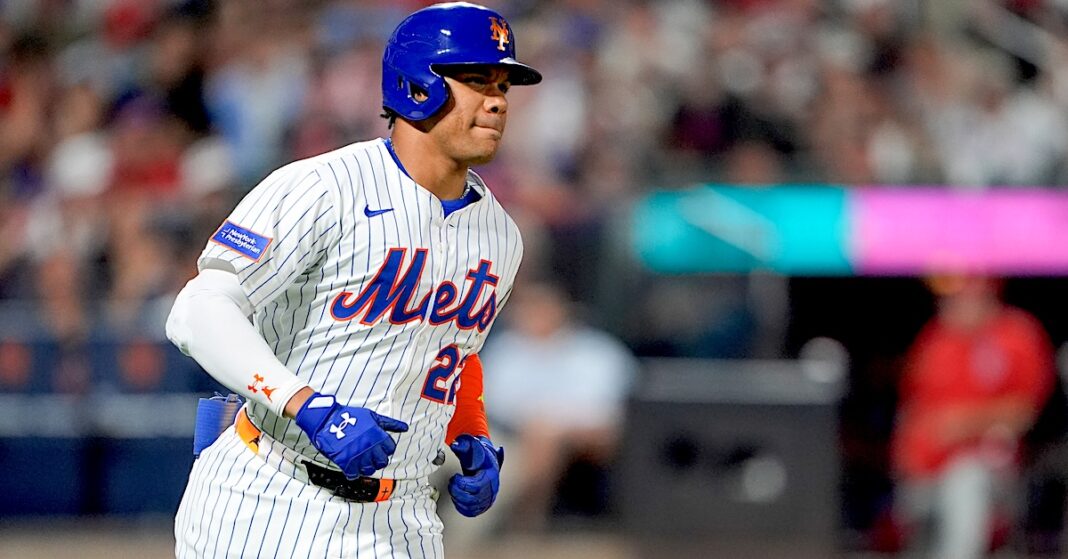

Juan Soto wants a Most Valuable Player award. Plenty of players give voice to outsized ambitions during spring training, but at this point in Soto’s career, the goal seems downright reasonable. The future Hall of Famer already has a World Series ring, a batting title, a stolen base crown, a Home Run Derby trophy, and bunch of All-Star nods and Silver Sluggers. Seeing as he’s unlikely to get a Gold Glove (barring some sort of trophy swap situation with Francisco Lindor), an MVP certainly seems like the next box to check. But as great as Soto has been since the moment he debuted for the Nationals in 2018, he doesn’t have a well-rounded game, and I’ve always had a sneaking suspicion that his weaknesses might keep him from ever winning an MVP. Now that it’s his stated goal, let’s take a closer look at his chances.
Soto is one of the best and most consistent players in the game. According to JAWS, he’s already the 36th-best right fielder of all time, and he’s still three years too young to be the president (in the Dominican Republic; he’s eight years too young in the USA). Since his first full season in 2019, he’s missed an average of just seven games per season and he’s never put up a wRC+ below 143. In any given season, if you had to pick the player most likely to rack up at least 5.0 WAR, Soto would be your guy. But his game is also incomplete. He’s the second coming of Ted Williams, in ways both good and bad. He’s got the other-worldly plate discipline and the power, but he’s also got the putrid outfield defense.
Soto is well aware of his deficiencies. “I feel like everybody tries to do better than what they did before,” he told Anthony DiComo of MLB.com. “I would definitely love to be better around the bases and better around the outfield. Even hitting, I try to keep my hitting increased. Thank God I’ve been doing well the past couple seasons. I’ve been putting numbers up there, career highs and stuff like that. So I just want to keep doing the same thing. I try to be better year after year.”
Across his eight-year career, Soto has missed the top 10 in the MVP voting just twice: his rookie season of 2018, when he didn’t debut until mid-May, and 2022, when his performance fell off (by his lofty standards, anyway) after a deadline trade to the Padres. But he’s always been right there. He finished third in the voting in each of the last two seasons, and he also has two second-place finishes under his belt. He really could have won it a bunch of times now! But it usually takes an outlier season to win the MVP, a season where you put it all together, and Soto has never quite had it all. He would have made a much better MVP candidate earlier in baseball history. Long gone are the days of Juan Gonzalez turning gaudy home run and RBI totals into trophies despite finishing below 5.0 WAR.
The convergence between sabermetric analysis and awards voting is well documented. “MVP winners with relatively low bWAR-related metrics all but disappeared by 2008,” wrote Benjamin Alter in the Spring 2023 Baseball Research Journal. “In the last 15 seasons, only one MVP winner (Bryce Harper in 2021) failed to finish in the top 5 in bWAR (Harper finished ninth among non-pitchers). Sixteen of the last 28 MVPs led their league in bWAR.”
We now have a couple more years of data to play with, so here’s how I’d couch the numbers: Over the past 10 years, 90% of MVPs have gone to a position player (or, in the case of Ohtani, a two-way player) who either led his league in bWAR or finished within 0.4 of the leader. In order to win an MVP, you either have to be the WAR leader, or be close enough that someone can make a plausible argument that the numbers are a wash.
You Aren’t a FanGraphs Member
It looks like you aren’t yet a FanGraphs Member (or aren’t logged in). We aren’t mad, just disappointed.
We get it. You want to read this article. But before we let you get back to it, we’d like to point out a few of the good reasons why you should become a Member.
1. Ad Free viewing! We won’t bug you with this ad, or any other.
2. Unlimited articles! Non-Members only get to read 10 free articles a month. Members never get cut off.
3. Dark mode and Classic mode!
4. Custom player page dashboards! Choose the player cards you want, in the order you want them.
5. One-click data exports! Export our projections and leaderboards for your personal projects.
6. Remove the photos on the home page! (Honestly, this doesn’t sound so great to us, but some people wanted it, and we like to give our Members what they want.)
7. Even more Steamer projections! We have handedness, percentile, and context neutral projections available for Members only.
8. Get FanGraphs Walk-Off, a customized year end review! Find out exactly how you used FanGraphs this year, and how that compares to other Members. Don’t be a victim of FOMO.
9. A weekly mailbag column, exclusively for Members.
10. Help support FanGraphs and our entire staff! Our Members provide us with critical resources to improve the site and deliver new features!
We hope you’ll consider a Membership today, for yourself or as a gift! And we realize this has been an awfully long sales pitch, so we’ve also removed all the other ads in this article. We didn’t want to overdo it.
By that standard, Soto should probably have an MVP already. In that 2021 season where Harper won the NL MVP with just 5.9 bWAR, Soto put up 7.3, most among National League batters, and second only to Zack Wheeler in the whole NL. (Wheeler arguably got hosed even worse than Soto. He lost the Cy Young to Corbin Burnes, who pitched unbelievably and even beat Wheeler in fWAR thanks to a 1.63 FIP, but threw just 167 innings to Wheeler’s 213 1/3.) Harper outslugged Soto, putting up a 170 wRC+ to Soto’s 164, but he played 10 fewer games, and most galling of all, his defense graded out even worse than Soto’s. This was also the year before the Phillies ended their postseason drought and advanced all the way to the World Series, so it’s not like Harper led a team to the playoffs and Soto didn’t.
While WAR isn’t perfect and shouldn’t be the sole determinant of MVP, it’s the purest distillation of how we think about player value. As Michael Baumann wrote two years ago, “It’s indisputable that baseball writers know more about the sport now than they did 20 years ago. And it’s not really because the old heads let the bloggers and nerds into the clubhouse. Everyone knows more about baseball now than they did 20 years ago.” Yesterday, I spoke to Noah Frank, who created a model to predict award winners for Baseball Prospectus. He pointed to another issue. “I think what has started to happen is, because everyone’s vote is public and because of social media, there is this pressure to not be the guy that goes against what everyone has agreed should happen,” he explained.
These days, you’re likely to have to defend your award picks publicly. Here at FanGraphs, we run articles explaining the thinking behind our picks every year one of us has a vote. It’s a lot harder to explain a gut feeling, or in the case of 2025, to make the completely fair argument that WAR underestimates the million extra contributions of catchers. “As little as five years ago, Cal Raleigh wins over Aaron Judge,” said Frank. “I’m certain of that.” Five years ago is an instructive timeframe, as that’s the year Harper won with just 5.9 bWAR. Since then, every MVP winner has put up at least 7.7 bWAR, a figure Soto has only reached once in his career.
Batting is by far the most important component, but WAR is an overall number. That means it dings players like Soto whose games are pointy rather than well-rounded. Soto’s ugly defense is no match for his mighty bat. It’s not going to keep him from being one of the game’s most valuable players any time soon. But it has already, multiple times, kept him from being the most valuable.
That brings us at last to the elephant in the room. Shohei Ohtani, who has won three straight MVPs and four in the last five years, is the player who sparked this conversation in the first place. “I’m going to be there every year too,” Soto said before finishing his sentence in a manner that all but begs to be taken out of context, “so he better keep doing what he’s doing, because I’m coming.” Ohtani’s two-way play is not just thrilling and unique, but a reliable way to rack up WAR. “It’s really hard to not reward what he’s doing when the numbers are better,” said Frank. “You’re going to have to beat him on paper.”
I didn’t plan on it, but my conversation with Frank ended up being just as much about Ohtani as Soto. “The hardest thing for me to do now in terms of the model is trying to figure out how to quantify what Shohei is doing,” he said. “The MVP is a position player. All the inputs that go into it are position player metrics. How do I represent that?” The answer, he found, was simply to model Ohtani as a position player, then dump his pitcher WAR on top of it. As long as Ohtani has that propping up his floor, Soto’s going to be at a disadvantage. “You hate to say this because this is so deeply unfair to him,” said Frank, “but I think his best bet of winning an MVP is probably Shohei encountering more arm injuries.”
Now that I’ve written all that depressing stuff, let’s talk about the many reasons I might be wrong. First, defensive numbers are fluky. They’re heavily dependent on the opportunities you get. Even if Soto’s defense never improves, he could still have a couple seasons where it grades out fine. He has a strong arm, and he has put up good throwing numbers in the past. Now that he’s playing in left field, he might have a few more chances to throw runners out at third base.
Also working in Soto’s favor is that bWAR tends to be the most widely referenced flavor of WAR in the MVP discussion, and its defensive component is calculated using Defensive Runs Saved. Among the big three advanced defensive metrics, DRS is by far the high-man on Soto’s defense. Since 2020, Statcast’s Fielding Run Value has Soto at -29 runs, eighth worst in baseball. Baseball Prospectus’ Deserved Runs Prevented has him at -9.7, 18th worst in the game. DRS has Soto at -13, 79th worst in the game. That’s still a far cry from good, but thinking he’s just regular bad instead of worst-in-baseball bad is a huge step up.
We also need to acknowledge that Soto’s baserunning has taken a big jump. From 2020 to 2024, Soto had never once been a net positive on the bases. He is slow. He’d never stolen more than 12 bases in a season, and he wasn’t great at taking the extra base. But in 2025, he led the NL with 38 stolen bases and finished 22nd in baserunning value. We’ve written about this more than a few times, and the general consensus around the league was that first base coach Antoan Richardson was largely responsible for the Mets’ sudden ability to steal bases at will. That’s not to say that Soto wasn’t working hard on the intricacies of baserunning, but at one point, he at least made it sound like he was simply running whenever Richardson told him to go. After some confusing negotiations, Richardson left New York for Atlanta this winter. It remains to be seen whether Soto’s sudden baserunning ability will leave town, too. If it doesn’t, if he can keep his baserunning somewhere around neutral, it would be a big help.
It’s also possible that Soto could simply mash his way to an MVP. He’s nearly done it several times now, and this is a situation where the case of the Splendid Splinter is instructive. Williams won the AL MVP in 1946 and 1949. In those two years, he led the AL (and all of baseball) in WAR. His defense was still bad, but he ran a 211 wRC+ in 1946 and a 181 wRC+ in 1949. Even by modern standards, he hit so well that the rest just didn’t matter. Soto is certainly capable of reaching those heights. Williams’ 181 mark from 1949 matches Soto’s full-season high, and he also put up a 202 wRC+ in the short 2020 season. Moreover, Soto’s power numbers are on the upswing. He’s exceeded 40 homers in the last two years because he’s hitting the ball harder than ever and putting it in the air much more frequently. Maybe he’s got an Aaron Judge season in him, and as Frank pointed out, being on a Mets team that’s determined to win could also be useful. “The Mets are going to be good,” he said. “They’re going to put good hitters around and behind him. That’s going to add to his counting stats.”
The last piece of good news is that Soto has plenty of time. He’s just 27 years old, and as recently as 2022, the 34-year-old Paul Goldschmidt won the NL MVP. It’s not a stretch to assume that Soto has eight years to achieve his goal. That’s a lot of bites at the apple, and it brings us back to Ohtani, who is four years older than Soto. If nothing else, we should expect Ohtani to start his decline first, while Soto is still in his prime. I also don’t think it’s a given that voters will continue to value Ohtani the way Frank’s model does – simply adding his pitching WAR onto his credentials as a hitter – when he either has a down year or starts to decline.
Let’s use the 2025 season as an example. Even without his pitching, Ohtani led all NL batters in two versions of WAR, but he was behind Geraldo Perdomo, who provided excellent baserunning and defense, in bWAR. With the pitching, he was the obvious, unanimous choice, but without it, he wouldn’t have been a runaway champion. Now let’s tweak his numbers some.
Say, in a future season, instead of producing a 172 wRC+, Ohtani runs the 142 he put up in 2022. It’s enough to keep him in Soto’s league, but it’s still clearly a bit behind a typical Soto season. (Soto’s career wRC+ is 158, and only once in the last six seasons has he finished with a mark below 150.) Now, say Ohtani’s pitching falls off some, too. He makes 25 starts, but his ERA and FIP are up around 4.00. It would add two or three wins to his WAR total, pushing him safely past Soto. Once again, he would put up more value than anybody else, and once again he’d be doing it in a way that nobody else can compete with. But crucially, he’d no longer be spectacular in either facet of the game. He’d be a great hitter who’s also not that far removed from an innings eater. That would make him the undeniable leader in WAR, but we might start to view him a little differently. We might start to see a distinction between the most valuable player in the league and the Most Valuable Player award winner.
Now, combine that scenario with the voter fatigue that is bound to kick in at some point when one guy has won four of the last five MVPs. Lastly, consider the correlate of voter fatigue. At some point, voters will start to worry that first ballot Hall of Famer Juan Soto is in danger of retiring without a single MVP award. The lifetime achievement MVP is harder to come by these days, when the voting is so WAR-focused, but that sentiment could certainly give a player like him a little boost.
As I said at the outset, my gut has told me for a while now that Soto is unlikely to win an MVP. It’s certainly not impossible, and time is on his side for a couple of reasons, but it will take something special. Unless he finds yet another gear at the plate for an entire season, or unless there’s another season like 2021, where the standards are a little bit lower, he will continue to be the maid of honor. And even if one or two of those things do happen, Shohei Ohtani could always swoop in and object to this union with with a combined WAR of 11.0. Should I have started this wedding metaphor before the final paragraph of the article? Yes, that would have been the best course of action. But if Juan Soto has taught us anything, it’s that second or third best can be pretty damn good, too.