

In chess, self-control is often treated as a key ingredient for improvement. Strong players are assumed to be more disciplined and focused as well as willing to push through difficult study sessions. Thus, it seems reasonable to think that this discipline translates into higher Elo. Many players believe that if they could be more consistent and self-controlled, their rating would rise accordingly. How much does self-control actually explain once we look at data from competitive players?
Gerrit Hourigan is a FIDE Master and psychology student. One of the winners of the 2025 Chessable Research Awards, Hourigan examines the aforementioned question using data from 270 FIDE-rated players. Drawing on research into deliberate practice, cognitive ability and early skill development, the author tests whether self-control predicts Elo directly or indirectly through greater amounts of structured training. The findings indicate that self-control plays a smaller role than commonly assumed, while earlier chess onset and sustained, structured practice correlate to higher ratings.
How Much Does Self-Control Really Matter in Chess Improvement? By Gerrit Hourigan
Introduction
In chess, discipline is often seen as a key ingredient of success. Strong players are described as focused, self-controlled, and willing to work through difficult study material. It seems reasonable to assume that players with higher self-control achieve higher Elo ratings, partly because they invest more time in serious training.
At the same time, research on expertise emphasizes deliberate practice—structured, feedback-rich training aimed specifically at improvement—as an important predictor of high performance in domains such as music, sports, and chess (Ericsson et al., 1993; Charness et al., 2005). Other work highlights the roles of cognitive ability and the age at which a person begins regular practice (Burgoyne et al., 2016; Campitelli & Gobet, 2008).
My bachelor thesis examined how these factors work together in chess. Using data from 270 FIDE-rated players, I tested three main questions:
1. Do players with higher trait self-control have higher Elo ratings?
2. If so, is this because they have done more structured deliberate practice?
3. How does self-rated cognitive ability and age of chess onset impact the relationship between practice and Elo?
Background
Self-control is the ability to regulate impulses, emotions, and attention in line with long-term goals. Higher self-control has been linked to better academic performance, fewer behavioral problems, and more favorable life outcomes, even when intelligence is taken into account (Duckworth & Seligman, 2005; Moffitt et al., 2011). In chess, self-control seems relevant both for maintaining study routines and for staying focused and emotionally stable during long games.
The deliberate practice framework proposes that expertise develops through sustained, structured training designed to improve performance and guided by feedback (Ericsson et al., 1993). In chess, such activities include analyzing one’s own games, solving tactical and endgame exercises, and studying annotated games. Studies in chess find that deliberate practice hours are positively related to Elo, though practice does not fully determine skill (Campitelli & Gobet, 2008; Charness et al., 2005). Learning typically shows diminishing returns: early practice brings larger gains, and additional hours yield smaller improvements (Newell & Rosenbloom, 1981).
Cognitive ability and starting age are also relevant. Meta-analytic work indicates that cognitive abilities such as reasoning and working memory are modestly associated with chess skill (Burgoyne et al., 2016). Players who begin regular chess practice earlier often reach higher levels of expertise (Campitelli & Gobet, 2008). Any attempt to understand the roles of self-control and practice should therefore consider ability and age of onset.
Method
Participants
The sample consisted of 270 FIDE-rated players who completed an online questionnaire in German or English. The mean age was 36.8 years (range: 11–76), and the mean Elo was 1877, with most participants in the strong club to expert range. The gender distribution reflected typical competitive chess demographics and was predominantly male.
Measures
• Elo rating. Participants reported their current FIDE Elo, which was screened for implausible values.
• Self-control. Trait self-control was assessed with the 13-item Brief Self-Control Scale (Tangney, Baumeister, & Boone, 2004), averaged to a score from 1 to 5.
• Deliberate practice. Lifetime hours of structured chess practice were estimated across several age bands (e.g., <10, 10–17, 18–24), following previous chess research (Campitelli & Gobet, 2008; Charness et al., 2005). Practice included activities such as game analysis, solving exercises, and coach-guided training.
• Self-rated cognitive ability. Participants rated their general cognitive ability (reasoning, learning, problem-solving) relative to other FIDE-rated players of the same age and gender on a 1–9 scale (Freund & Kasten, 2012).
• Background variables. Age, gender, and age of chess onset (age at which regular play began) were recorded.
Analysis overview
The analysis followed a preregistered plan. In brief:
• I examined whether self-control was associated with Elo when age, gender, age of onset, and self-rated cognitive ability were taken into account.
• I tested whether players with higher self-control reported more structured practice, and whether this could explain any link between self-control and Elo.
• I checked whether the practice–Elo relationship was influenced by self-rated cognitive ability and age of chess onset.
Results
Descriptive patterns
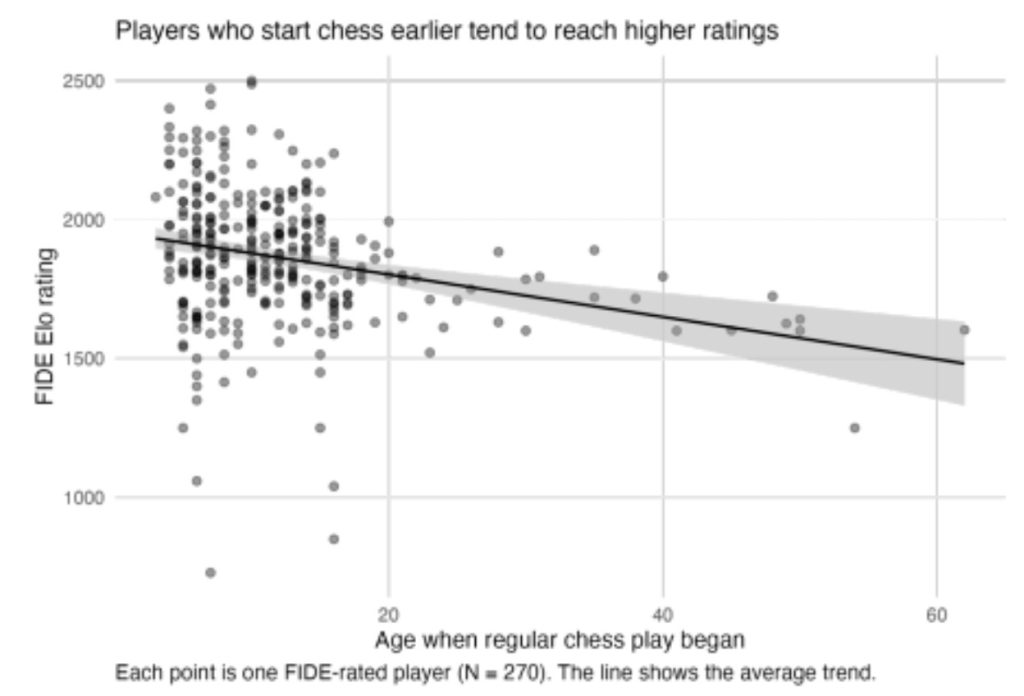
On average, players reported about 2,700 lifetime hours of structured practice, with substantial variation across individuals. Elo was positively related to structured practice and to self-rated cognitive ability, and negatively related to age of chess onset: players who started chess later tended to have lower ratings.
Self-control showed a small positive correlation with practice, but little direct association with Elo.
Self-control and Elo
When Elo was predicted from self-control, self-rated cognitive ability, age, age of onset, and gender, the main findings were:
• Self-control did not significantly predict Elo. The estimated effect was small and statistically non-significant.
• Self-rated cognitive ability was positively associated with Elo: players who rated their cognitive ability higher tended to have higher ratings.
• Age of chess onset was a robust predictor: each additional year of later onset was associated with roughly 7–8 Elo points lower, on average.
Within this sample of active FIDE-rated players, trait self-control was not a meaningful determinant of current Elo once other factors were considered.
Deliberate practice and diminishing returns
To describe the size of the practice effect in an interpretable way, I focused on doublings of lifetime structured practice. A clear pattern emerged:
• Each doubling of lifetime structured practice was associated with approximately +24 Elo, controlling for age, gender, self-rated cognitive ability, and age of onset.
This pattern is consistent with diminishing returns. Large increases in structured practice are associated with higher Elo, but each additional hour contributes less at higher practice volumes than at lower ones.

Does practice explain any effect of self-control?
The study also tested whether self-control might matter indirectly, by increasing structured practice, which then improves Elo. In other words, do more self-controlled players practise more, and is that why they are stronger?
In this sample, the answer was essentially no:
• Self-control had only a weak link to practice hours;
• Once practice was taken into account, there was still no meaningful association between self-control and Elo;
• The estimated indirect effect of self-control on Elo via practice was not significant.
Overall, the data did not support the idea that self-control contributes to chess skill, either directly or by increasing structured practice.
Cognitive ability, practice, and Elo
An exploratory analysis examined whether self-rated cognitive ability influenced Elo via structured practice. The pattern suggested an indirect pathway:
• Players who rated their cognitive ability higher reported more structured practice; • More practice, in turn, was associated with higher Elo;
• Once practice was included, the direct link between self-rated ability and Elo became much weaker.
This pattern suggests that beliefs about one’s cognitive ability may influence how much structured practice players undertake, and that practice, rather than perceived ability alone, is what relates to stronger performance.
Discussion and Conclusion
The study set out to test a widely held idea: that players with higher self-control reach higher ratings, partly because they do more serious practice. The findings did not support this model.
Instead, two variables were consistently related to chess skill:
• Age of chess onset – players who began playing chess regularly at earlier ages tended to have higher Elo ratings;
• Structured deliberate practice – doubling lifetime structured practice was associated with a modest increase in Elo, with diminishing returns at higher practice volumes.
These results align with broader expertise research emphasizing the importance of early, structured engagement in a domain, combined with extensive, goal-directed, feedback-rich training.
The absence of a clear self-control effect does not mean that self-control is irrelevant in chess. It likely plays a role in maintaining routines and regulating emotions. However, within this group of already committed, FIDE-rated players, trait differences in self-control did not emerge as a major source of rating differences.
Finally, the exploratory result on self-rated cognitive ability points to a motivational mechanism: players who see themselves as cognitively capable may invest more in structured practice, which then supports higher performance. Testing this idea will require longitudinal designs and objective cognitive measures.
In summary, data from 270 FIDE-rated players suggest that earlier chess onset and greater amounts of structured, deliberate practice are the most consistent correlates of higher Elo in this sample, with practice showing clear diminishing returns. Broad personality traits such as self-control appear less central than the timing and quality of chess-specific training.
References
Burgoyne, A. P., Sala, G., Gobet, F., Macnamara, B. N., Campitelli, G., & Hambrick, D. Z. (2016). The relationship between cognitive ability and chess skill: A comprehensive meta analysis. Intelligence, 59, 72–83.
Campitelli, G., & Gobet, F. (2008). The role of practice in chess: A longitudinal study. Learning and Individual Differences, 18(4), 446–458.
Charness, N., Tuffiash, M., Krampe, R. T., Reingold, E., & Vasyukova, E. (2005). The role of deliberate practice in chess expertise. Applied Cognitive Psychology, 19(2), 151–165.
Duckworth, A. L., & Seligman, M. E. P. (2005). Self-discipline outdoes IQ in predicting academic performance of adolescents. Psychological Science, 16(12), 939–944.
Ericsson, K. A., Krampe, R. T., & Tesch-Römer, C. (1993). The role of deliberate practice in the acquisition of expert performance. Psychological Review, 100(3), 363–406.
Freund, P. A., & Kasten, N. (2012). How smart do you think you are? A meta-analysis on the validity of self-estimates of cognitive ability. Psychological Bulletin, 138(2), 296–321.
Moffitt, T. E., Arseneault, L., Belsky, D., Dickson, N., Hancox, R. J., Harrington, H., Houts, R., Poulton, R., Roberts, B. W., Ross, S., Sears, M. R., Thomson, W. M., & Caspi, A. (2011). A gradient of childhood self-control predicts health, wealth, and public safety. Proceedings of the National Academy of Sciences, 108(7), 2693–2698.
Newell, A., & Rosenbloom, P. S. (1981). Mechanisms of skill acquisition and the law of practice. In J. R. Anderson (Ed.), Cognitive skills and their acquisition (pp. 1–55). Erlbaum.
Tangney, J. P., Baumeister, R. F., & Boone, A. L. (2004). High self-control predicts good adjustment, less pathology, better grades, and interpersonal success. Journal of Personality, 72(2), 271–324.