
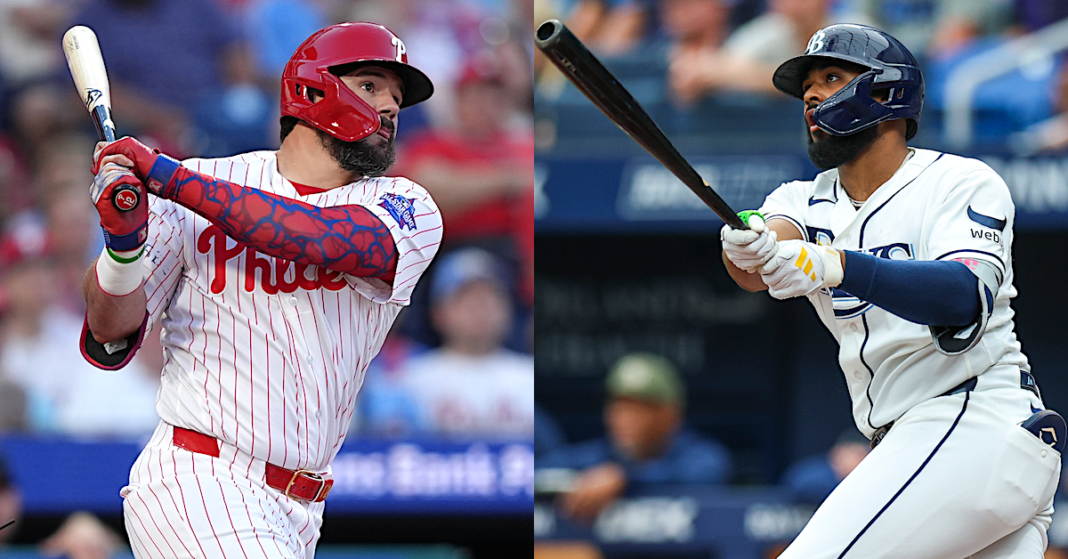

Break out your biggest, dumbest hats, friends. It’s time for the Derby. The 2026 Home Run Derby is at 8:00 PM Eastern tonight at Citizens Bank Park in Philadelphia. It will be streaming on Netflix, which means that in just a few hours, my parents (and probably your parents too) will discover that they have no way of watching it. If the streaming service’s official trailer for the event is any indicator, the action will be pixelated electric. There’s no Statcast broadcast this year, but the Derby will apparently be a crossover event with Hot Ones, the show where celebrities answer questions while eating chicken wings. If you tune in too late for the dingers, you can console yourself by watching Will Ferrell get very sweaty.
Every year’s preview contains a section in which we bemoan the absence of some of the game’s biggest stars, and though it would be great to see Shohei Ohtani, Aaron Judge, or Yordan Alvarez, we honestly can’t complain about this field at all. It’s fantastic. It’s got three of the top four home run hitters this season, and six of the top 20. It’s got hometown favorites. It’s got one surefire Hall of Famer. It’s got a mix of first-timers and previous winners and runners-up. It’s got a mix of young players and established stars. It’s got participants from four countries. Most of all, it’s filled from top to bottom with jaw-dropping, light-tower, into-the-next-county power.
Every single participant has plus bat speed and a huge hard-hit rate. We don’t have any filler. Nobody feels like a last-minute replacement, and nobody made it just because of a fluky first half or because they can combine average power with a high pulled-fly ball rate. Every single participant can mash, and none of them would be a surprise winner. Moreover, although practitioners of this brutalist version of baseball can sometimes struggle toward the end of the competition, when they’re tuckered out from all those daddy hacks, that may be less of an issue thanks to this year’s new format, which we’ll get to in a moment.
The ballpark should also help. Citizens Bank Park is a notoriously cozy venue that enables home run hitting. Statcast’s park factors rate it the fifth-friendliest home run park in baseball. However, that number isn’t exactly balanced. It plays roughly average for righties, while for lefties, it’s second only to Coors Field. The five lefties in the field should have the advantage.
The Rules
This year’s format change is drastic. After using a timer-based system since 2015, the league is going to a swing-based format. That’s actually different from the pre-timer format. In the past, players got a certain number of outs, which is to say non-homers, in each round. This year, it’s about swings. Each player gets 20 swings in the first round, and 15 in the second round and the final. However, the last swing of each round works like the old out system. You can’t end a round on a home run, so as long as you keep hitting homers, the round can go all night long.
This is a clever wrinkle, because it means that no matter how far behind he is, each player technically has a chance until he makes that final out. No longer will we watch players fall behind and know that, even with two minutes still on the clock, all their efforts will be futile. It’s also an annoying wrinkle, though, because that final ball has officially been branded the “T-Mobile Magenta Ball.” I’m not sure the enjoyment derived from giggling about the fact that this sounds like an embarrassing medical affliction will be worth the stultifying quantity of cellphone advertising that’s about to slam into our skulls.
You Aren’t a FanGraphs Member
It looks like you aren’t yet a FanGraphs Member (or aren’t logged in). We aren’t mad, just disappointed.
We get it. You want to read this article. But before we let you get back to it, we’d like to point out a few of the good reasons why you should become a Member.
1. Ad Free viewing! We won’t bug you with this ad, or any other.
2. Unlimited articles! Non-Members only get to read 10 free articles a month. Members never get cut off.
3. Dark mode and Classic mode!
4. Custom player page dashboards! Choose the player cards you want, in the order you want them.
5. One-click data exports! Export our projections and leaderboards for your personal projects.
6. Remove the photos on the home page! (Honestly, this doesn’t sound so great to us, but some people wanted it, and we like to give our Members what they want.)
7. Even more Steamer projections! We have handedness, percentile, and context neutral projections available for Members only.
8. Get FanGraphs Walk-Off, a customized year end review! Find out exactly how you used FanGraphs this year, and how that compares to other Members. Don’t be a victim of FOMO.
9. A weekly mailbag column, exclusively for Members.
10. Help support FanGraphs and our entire staff! Our Members provide us with critical resources to improve the site and deliver new features!
We hope you’ll consider a Membership today, for yourself or as a gift! And we realize this has been an awfully long sales pitch, so we’ve also removed all the other ads in this article. We didn’t want to overdo it.
As in the two previous Derbies, the first round will function as pool play. The four hitters with the most homers in the first round will enter a bracket, seeded by their first-round totals. Any ties in the first round will be decided by the length of each player’s longest home run. In the semifinals and final, the tiebreaker will be a three-swing swing-off.
The format contains one more odd wrinkle. In previous years, the order of the first-round pool play was determined by how many home runs each player hit in the first half. This year, the rules say the hitters “will hit in an order determined by the Commissioner’s Office.” I have no idea what would constitute an optimized order to the commissioner. However, I’m sure that somebody out there will disapprove of that order, so I hope they appreciate the gift of having a reason to complain about Rob Manfred before the Derby even starts.
The format change involves some tradeoffs. We lose the immediacy and adrenaline rush of a ticking clock. However, we gain the ability to enjoy each home run. No longer will we need a split screen or a camera that careens wildly from the infield to the outfield in order to see where the previous ball landed without missing the current swing. The big situations will get a moment to breathe, as will the big sluggers.
The new format is also a bit more fair. In previous Derbies, the pitcher wasn’t allowed throw the next ball until the previous one landed, but some teams – I’m looking at you, 2018 Bryce Harper and 2018 Bryce Harper’s dad – simply flouted that rule and gained a huge advantage. That will be off the table. We’ll also be free of gimmicky distance-based bonus rounds. Another effect of the new format is that a bad pitcher might be less of a handicap. Without a time limit, there’s no downside to taking a couple extra pitches and offering only at the tenderest of meatballs.
As for why the league changed the format again, why it’s constantly changing the format, I can’t really tell you. I’m excited about this new version. I think it’ll be more watchable than the timed version. But honestly, whatever problem the league has with the Home Run Derby, I think the format is rarely the culprit. The Derby always starts to drag halfway through because it runs for three hours, and that’s simply too long. Even the best, most exciting Derby is not a Christopher Nolan movie. It’s a one-note symphony, a fireworks display, and fireworks displays rarely last more than half an hour because eventually all those bangs and zooms start to blend together and get monotonous.
In order to stretch a Home Run Derby out for three hours, you need a bracket, multiple rounds, rest periods, convoluted bonus systems, indecipherable graphics, interviews with celebrities you wish you’d never heard of, and a full hour of commercials. You spend the whole time waiting for the good part, and because the contestants get physically tired, the good part can sometimes be a letdown. If the goal is to make the Home Run Derby as exciting as it can be, then the solution is to bring it down to a brisk 90 minutes. That probably won’t happen, because it means less advertising money, but changing the format is never going to solve that particular problem.
Alright, you’ve waited long enough. Let’s get to the large home-run-hitting men!
2026 Home Run Derby Power Profiles
| Player | HR | HH% | Bat Speed | EV | EV90 | maxEV | HR/FB | Brl% | AVG HR Dist | AVG FB Dist |
|---|---|---|---|---|---|---|---|---|---|---|
| Kyle Schwarber | 32 | 53.1% | 77.1 | 93.4 | 109.1 | 113.2 | 32.0% | 19.3% | 404 | 342 |
| Ben Rice | 29 | 47.6% | 72.5 | 92.1 | 105.5 | 110.9 | 29.3% | 14.9% | 389 | 337 |
| Junior Caminero | 28 | 51.6% | 79.9 | 93.3 | 111.1 | 116.9 | 29.2% | 13.6% | 408 | 324 |
| Jordan Walker | 22 | 51.5% | 79.2 | 94.2 | 111 | 116.6 | 22.4% | 14.1% | 406 | 329 |
| Munetaka Murakami | 20 | 59.2% | 75.2 | 94.1 | 108.7 | 114.1 | 35.1% | 20.0% | 409 | 348 |
| Willson Contreras | 20 | 46.7% | 77 | 90.6 | 108.9 | 114.4 | 21.1% | 14.2% | 407 | 336 |
| Bryce Harper | 20 | 46.2% | 74.4 | 90.1 | 106.7 | 113.5 | 20.6% | 11.3% | 400 | 336 |
| Jac Caglianone | 15 | 56.0% | 77.3 | 92.9 | 110.5 | 116.1 | 22.7% | 14.7% | 414 | 333 |
Kyle Schwarber
No matter what criteria you’re using to assess the Derby participants, Schwarber has to be a favorite. He’ll be in front of a raucous home crowd, and he has a history of showing up in big moments. At 33, he’s on the best two-year stretch of his entire career. He leads baseball with 32 home runs. As a matter of fact, since his debut in 2015, his 372 homers are second only to Aaron Judge’s 385 (and as Judge will be on the IL for at least another month, probably longer, Schwarber may just pass him). Schwarber has Derby experience, finishing second behind Harper in 2018 and going out in the first round in 2022. Maybe even more relevant considering this year’s format, he absolutely blew the roof off last year’s All-Star Game by laying waste to the swing-off.
Schwarber’s average launch angle of 21.8 degrees is the highest of the field by a mile and the sixth-highest among all qualified players. His 19.3% barrel rate ranks second in the field and fifth in baseball. Not only does it help that he is a lefty at Citizens Bank, but he is a pull machine. His average attack direction – the horizontal angle of his bat at the moment of impact – is 10 degrees toward the pull side, one of the most extreme marks in the game, and 16.9% of his batted balls are pulled fly balls, the highest mark in the group by a lot. At 25%, Schwarber also has the third-lowest chase rate in the field, and as players can take pitches to their hearts’ content waiting for the right one, that could end up being a difference-maker. But these are just numbers, and the argument for Schwarber is more visceral than that.
Ben Rice
Ben Rice debuted in 2024, and he’s done nothing but crush dingers ever since. He hit 26 last year, and he already has 29 this year. That’s the third most in baseball and the second most among Derby contestants. Still, if there is an underdog in this group, it’s probably Rice. The Big Grain (as everyone will soon by calling him) has the slowest bat speed of the field by quite a bit. He just doesn’t have the top-end power of the rest of the field. His average home run is the shortest of the bunch, and he’s benefited from Yankee Stadium’s shorter right-field dimensions. However, you know who had the shortest average homer in last year’s Derby? Winner Cal Raleigh. Additionally, as a lefty in Citizens Bank Park, Rice will have a similar advantage to the one he has at Yankee Stadium, and despite his relative shortcomings, he’s certainly not a weakling.
Rice ranks third among the group in barrel rate and home runs per fly ball. He leads all of baseball with a .320 isolated slugging percentage. He’s also coming into the Derby on a tear. Over his final 12 games of the first half, Rice batted .349 with a 259 wRC+ and seven home runs.
My biggest concern is that Rice is having his dad pitch to him. Now, Rice’s dad did pitch in college and has been throwing him BP for his entire life, and Rice also has the second-lowest chase rate of the field, but still, I think I’d rather have Dino Ebel.
Junior Caminero
If you’re simply looking for the most powerful player in the Derby, Caminero is your guy. His 28 home runs rank fourth in the majors. He has the fastest bat speed and the longest swing of any qualified player. He leads the Derby Field in 90th-percentile exit velocity, max exit velocity, fast-swing rate, and blast rate. The one thing he struggles at is getting the ball in the air. With a swing path tilt of just 24 degrees and an attack angle of just eight degrees, Caminero possesses one of the flattest swings in all of baseball. He’s got the second-lowest fly ball rate of the group, and his average fly ball travels the shortest. Hard-hit line drives are fantastic in baseball, but they can be killers in the Derby.
Still, Caminero has to be a favorite. He finished second in last year’s Derby, and the fact that he’s back certainly indicates that he’s in it to win it. He’s running it back with Rays major league field coordinator Tomas Francisco pitching to him again. Moreover, Caminero can hit absolutely anything out of the park. Here’s a side-by-side pitch chart of the home runs Caminero and Caglianone have hit. Caglianone has a sweet spot. He needs the ball middle up. But Caminero doesn’t care at all where you throw the ball.

Of course, this effect might matter just a little bit less in an untimed Derby, because batters can take as many pitches as they’d like, waiting for one that’s right in their sweet spot. But nobody’s perfect at this. Every pitch looks juicy in the Derby. And for Caminero, every pitch really will be.
Caminero is also coming into the Derby red-hot. Over his last 19 games, he’s batting .292 with a 227 wRC+, an .861 slugging percentage, and 13 home runs. Yeah, 13 homers in 19 games is pretty good.
Jordan Walker
The argument for Walker is the same as the argument for last year’s winner, Cal Raleigh: This is just his year. After big prospect hype and even bigger struggles in his first few seasons in the majors, Walker is finally putting it all together. He’s coming into the break with a 143 wRC+ and 22 home runs. He’s finally figured out how to lift the ball enough to take advantage all the power his 6-foot-6 frame can generate. Walker ranks second in the field in a bunch of big categories: bat speed, average exit velocity, 90th-percentile exit velocity, max exit velocity, and fast-swing rate. He’s also yet another participant coming into the Derby on a tear. Over his last 12 games, he’s running a 208 wRC+ with four homers and a .707 slugging percentage. He’s got his normal BP pitcher, St. Louis bullpen catcher Kleininger Teran, throwing to him. However, Walker’s launch angle is still the question.
Just 5% of Walker’s batted balls have been pulled fly balls, and even if you also add line drives in there to look for pulled-air percentage, he’s still at the bottom of the field at 15%. He just struggles to get the ball in the air, and it’s hard to win a Derby that way. But it’s not impossible. Just ask Juan Soto and Vladimir Guerrero Jr. If Walker does win it all, it will be an unforgettable laser show. Also, he has been practicing:
Munetaka Murakami
The final addition to the field was an exciting one. Murakami hit at least 28 home runs in all six of his first full NPB seasons. Injuries shortened his 2025 campaign to just 56 games, but he managed to launch an astonishing 22 dingers during that stretch. Over a 162-game season, that would be a 63-homer pace. Even though injury has shortened his 2026 campaign too, he’s still on pace for 34.
Murakami is also jumping straight off the IL and into the Derby, so don’t let his relatively low total of 20 home runs fool you. He reached that figure despite missing 35 games with a hamstring strain, and only returned to the White Sox lineup on Friday. And don’t overlook him based on the fact that his top-end power is in the middle of this particular pack. He always hits the ball hard. He leads the field in hard-hit rate, average exit velocity, barrel rate, home runs per plate appearance, and home runs per fly ball. All he does is find a way to put the ball over the wall.
Here’s an example. Home run derbies are all about pulling the ball in the air, because the wall is shortest down the line. But Murakami doesn’t care about that. He’s great at hitting home runs even to the deepest part of the ballpark. Center field is where home runs go to die, but he’s tied with Nick Kurtz for the major league lead with nine home runs to straightaway center. That’s 41% of his homers going to the deepest part of the park, the highest mark in baseball (minimum 15 straightaway fly balls). Caminero is the only other member of the field above 30%.
The two concerns about Murakami before this season were that he might not be able to handle velocity, and that he definitely couldn’t hit breaking stuff. Neither of those will matter at all here. And the swing-based format might help him most of all. Murakami has the lowest chase rate in the field, and not by a small margin. He’s great at waiting for his pitch. He is made for home run derbies, and maybe for this format in particular.
Willson Contreras
I don’t really have a way to look this up, but I suspect Contreras is the first player ever to participate in the Derby in the middle of a suspension. He’s currently four games into a five-game suspension for his role in a June 30 benches-clearing brawl. For a few reasons – he was responding to racially inflammatory language, he was not in the best place emotionally due to the devastation in his home of Venezuela – Contreras came off as at least something of a sympathetic figure, even though he removed his helmet and threw it in the melee with the same motion as a Tim Tebow jump-pass. I’m about as pacifist as they come, but even I must admit there’s something poetic about watching a man use a piece of protective equipment as a weapon. Sure, you can beat your swords into plowshares, but that doesn’t have to stop you from launching those plowshares right at somebody’s noggin, now does it?
At 419 feet, Contreras has the longest average home run of anybody in the Derby. Wait, sorry, that’s his brother William Contreras. It’s a talented family is all I’m saying. In fact, Willson actually asked his brother to pitch to him in the Derby, which would have been so much fun. Unfortunately, William declined. Instead, Boston’s interim bench coach José David Flores will be stepping in. It won’t be as fun a story, but it’s definitely a wiser choice, as Flores throws BP to Contreras all the time.
Contreras possesses the game’s third-highest pull rate at 54.7%. The lack of red cells in the table above may make him look like something of an underdog, but I actually think he’s an interesting dark horse candidate. Being right-handed doesn’t help, and he’s definitely not the most powerful swinger of the bunch, but he doesn’t have any blue cells either. He’s toward the top in pull rate and pulled-fly ball rate. He also sounds genuinely excited to participate, and he has a sound strategy, telling reporters, “I think Philadelphia is a good stadium to hit. The ball carries a lot, and the key for me in the Home Run Derby is not trying to do too much or trying to hit it a long way. I already have a plan on what to do.”
Earlier, I mentioned that Caminero can hit any pitch out of the ballpark regardless of where it’s located. Contreras is similarly indiscriminate, but with regard to pitch type. Left-handed hitters Harper, Caglianone, Murakami, and Rice are fastball mashers. Each of them has hit at least 45% of his homers on four-seam fastballs. Fellow righties Caminero and Walker, along with the lefty Schwarber, are around 30%. Contreras is all the way down at 15%. This might not help him all that much when all he’s getting is batting-practice fastballs, but it does speak to an ability to send any pitch he sees over the fence.
Bryce Harper
Harper enters the fray coming off a very weird week. The announcement that he was entering the Derby came mere hours after the Philadelphia Inquirer reported that he had recorded a video message for FanDuel to a debt-ridden gambling addict who had lost $1.5 million to the company. However, the next day, Front Office Sports reported that the video had simply been ordered through Cameo, where anyone can buy a personalized video from Bryce Harper for $899. Harper definitely should have gotten suspicious when, according to FOS, the video was purchased by a FanDuel employee who also provided Harper with the script, but the story is not nearly as unsavory as it originally seemed. Why is Bryce Harper, who will make roughly $900 dollars for each 1.5 pitches thrown in a Phillies game this year, on Cameo at all? That’s a good question, but one for another day. The question for today is whether this bizarre situation will give Harper extra motivation to win back some love by mashing baseballs. God knows high-level athletes have used lesser slights to fuel themselves.
Harper is a hometown favorite and the only previous winner in the field. He also has perhaps the best pitcher in the field. Although he won the 2018 event with his father pitching to him, this time he selected Dodgers third base coach Dino Ebel. Ebel is as renowned as a BP pitcher can be, which is why he’s pitched in the Derby four times, including 2024, when he and Teoscar Hernández won the whole thing. Ebel also pitched to Schwarber during last year’s All-Star Game swing-off.
The 33 year-old Harper is running his lowest exit velocity and hard-hit rate of the decade, and at this point, his ferocious uppercut is far from the most powerful in the field. He’s got the lowest hard-hit rate, average exit velocity, barrel rate, home run per fly ball rate, and he’s second worst in bat speed, home run distance, and pulled-air rate. I don’t think anyone would be shocked to see Harper rise to the occasion and channel his precocious past, but at this point, the numbers say he probably shouldn’t be the favorite.
Jac Caglianone
At first blush, Caglianone might look like the odd man out here. He’s the low man by quite a bit in terms of home runs. His 15 homers put him a 12-way tie for 49th in baseball. His 4.3% home run rate per plate appearance is the lowest of the field. His dad is pitching to him. But Caglianone is a gargantuan slugger who was built for the Derby. He has the third-highest hard-hit rate among qualified players and the second highest in the field. He’s just one year removed from a rookie campaign in which he bashed 19 home runs over just 62 games, a 47-homer pace. And luckily, he doesn’t have to do any throwing. Perhaps you’ll recall that Statcast created a metric called blasts when they introduced bat-tracking data. The loose definition is a ball that is squared up with a bat speed above 82 mph. This season, 23.5% of his batted balls have been blasts, third highest in the field and ninth highest in baseball.
I showed you the pitch chart of Caglianone’s home runs earlier, with all of them coming belt high and up. It’s the opposite of what you’d expect from lefty sluggers, who typically drop their bat head on the ball and finish with their hands high. There’s nothing wrong with tomahawking high pitches like Caglianone does, but it tends to lead to a lot more line drives and topspin. Just 5.6% of Caglianone’s batted balls have been pulled fly balls, the second-lowest mark in the field. It also means that Caglianone needs to pick his pitches carefully, and that might be tough, as he has the highest chase rate among the eight contestants. He also has the fewest home runs per plate appearance in the group. However, on the flip side, he has the longest average homer at 414 feet. Now, some of this may come from playing at Kauffman Stadium, but it also speaks to the fact that when Caglianone gets ahold of the ball, it can go an awfully long way.
Who’s going to win?
Look, we never really know who’s going to win. We do the best we can with the information we have, but there’s so much randomness involved. That said, it’s Kyle Schwarber. After last year, I just can’t pick against Schwarber.