

Firouzja early leader
The fourth edition of the Quantbox Chennai Grand Masters began on Thursday. Unlike last year’s edition, which featured two concurrent ten-player events – the Masters and the Challengers – this year’s tournament consists of a single eight-player field.
Despite the reduction in size, the lineup remains formidable. Seven of the participants are rated above 2700, with Pranesh M completing the field after winning the Challengers in 2025. Top-ten players Nodirbek Abdusattorov and Arjun Erigaisi are the first and second seeds, while reigning world champion Gukesh Dommaraju is competing in his home city. Alireza Firouzja, Hans Niemann, Nihal Sarin and Dmitry Andreikin are the other participants.
Only one of the four games in the opening round ended decisively, although the three draws were all hard-fought encounters in which one player obtained strong winning chances.
Video: ChessBase India
Firouzja was the day’s sole winner, defeating underdog Pranesh with the black pieces. The result also lifted Firouzja, who had entered the event ranked 12th in the world, into the top ten of the live ratings list.
Playing a Sicilian Sveshnikov, Firouzja gained an edge out of the opening and maintained the pressure throughout the middlegame. He eventually won a pawn before simplifying into an endgame in which he had a rook, a knight and six pawns against two rooks and three pawns (i.e. three pawns for the exchange). Converting the position was far from straightforward, but Firouzja showed good technique to secure the full point.
Pranesh 0-1 Firouzja
Annotations by GM Karsten Müller
Top seed Abdusattorov found himself on the worse side of a Queen’s Gambit Declined despite having the white pieces against Niemann. The Uzbek grandmaster employed a rather experimental line and was forced to defend tenaciously in a pawn-down position before escaping with a draw.
Picture this: you’ve outplayed your opponent move by move, you’re clearly better – and then the endgame slips into a draw, simply because you lacked the crucial theoretical knowledge. That is exactly where this course comes in. Without solid endgame skills, there’s no way forward. Rook endgames are most essential: they occur more often than any other type of endgame, and often make the difference between victory and half a point. If you master them, you’ll confidently convert your advantages into wins!
Free video sample: Introduction
Free video sample: Bodycheck
Gukesh also needed to play accurately to hold his game with white against Nihal. The two Indian players entered the tournament with exactly the same rating, and Nihal obtained the better chances before the world champion managed to secure a draw.
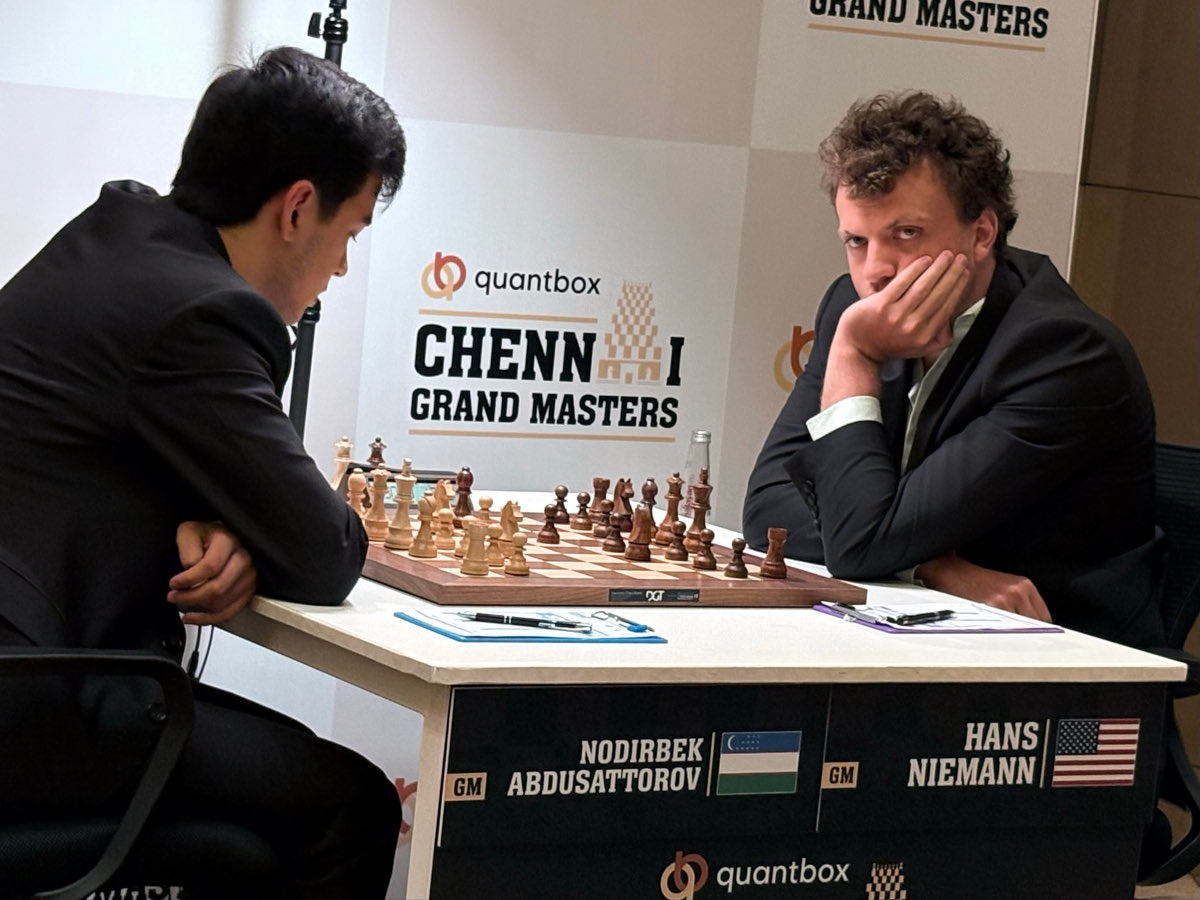
Nodirbek Abdusattorov v. Hans Niemann | Photo: Tushar Damor
The remaining game saw Andreikin escape with a draw against Erigaisi after 32.Qc7?! allowed him to force a perpetual check.
Erigaisi could instead have played 32.Rf3, keeping the pressure on his opponent. Although there was no straightforward continuation leading to a clear advantage, Erigaisi had around half an hour on his clock compared with Andreikin’s seven minutes and could have continued testing him in time trouble.
After the text move, however, there followed 32…Bxd2 33.Qxb7 (the rook is trapped on a6) Qb1+ 34.Kh2 Bf4+ 35.g3 Qc2
Erigaisi spent seven minutes before capturing the rook with 36.Qxa6, effectively agreeing to a draw since Black gets a perpetual check starting with 36…Qxf2+. Erigaisi correctly calculated that 36.Kg2 Qe4+ also led to a draw by perpetual.