
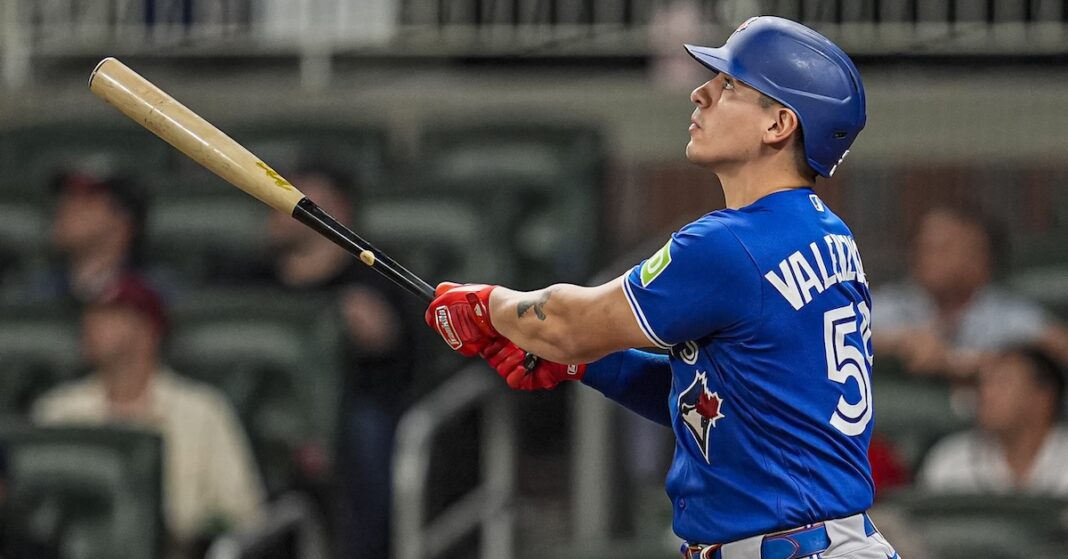

Welcome to “Wait, What?!,” a series in which I’ll take a look at some of the players whose performance has most surprised me this season. These will all be guys I covered as part of this season’s list cycle. It’s important to reflect on previous work, and in cases where the numbers don’t match the scouting report, there’s often a lesson to be learned, or at least something to keep in mind going forward.
While it can be useful to let a report marinate for a couple years before looking back, sometimes a player’s production prompts a quicker postmortem. Such is the case with Blue Jays catcher Brandon Valenzuela, who has accumulated 1.6 WAR in his first 59 career games mere months after I projected him as a glove-first backup on Toronto’s farm system overview. Let’s take a deeper look at how we got from A to B, evaluate whether I should have seen this kind of production coming, and reflect on whether Valenzuela’s breakout warrants a re-evaluation. Perhaps we’ll even learn something, something to think about when it comes time to evaluate the next upper-level catcher who looks like a defense-first reserve. We’ll begin with a look at Valenzuela’s tool grades and scouting report from January, which I’ve reproduced below:
Signed: July 2nd Period, 2017 from Mexico (SDP)
| Age | 25.3 | Height | 6′ 0″ | Weight | 225 | Bat / Thr | S / R | FV | 40 |
|---|
Tool Grades (Present/Future)
| Hit | Raw Power | Game Power | Run | Fielding | Throw |
|---|---|---|---|---|---|
| 30/40 | 45/45 | 30/40 | 30/30 | 50/55 | 60 |
A glove-first catcher, San Diego traded Valenzuela to Toronto last summer in a deadline deal for Will Wagner. The 25-year-old has kicked around the mid-to-upper levels for a couple years now and heads into the 2026 season as the club’s third catcher.
Defensively, Valenzuela is a solid receiver with strong hands and wrists. His framing numbers were just fair last year, possibly due to a little extraneous body movement and a tendency to stay high in his crouch. He has a good arm and a lightning-quick release, but he’s not always synched up and his throws can scatter. The tradeoff has been worth it so far, as Valenzuela has hosed a third of the Triple-A basestealers he’s encountered, but it’s something to monitor. At the plate, he has a backup catcher’s stick. He’s a switch-hitter with enough power that pitchers have to take him seriously, but his grooved, uphill swing and fringy bat speed put a firm lid on his hit tool. It’s more of a useful package of skills than an exciting one, but catchers who can chip in on both sides tend to play for a long time. Valenzuela’s intangibles have drawn rave reviews from Toronto’s staff, and he projects to take over as the Jays’ backup sometime in the next couple of years.
2026 Performance to Date
Brandon Valenzuela’s 2026 Production
| PA | BA | OBP | SLG | BB% | SO% | wRC+ | DEF | WAR |
|---|---|---|---|---|---|---|---|---|
| 191 | .237 | .316 | .414 | 10.5% | 25.7% | 105 | 8.3 | 1.6 |
Toronto fans tried to vote every Blue Jays regular and their cousin into the All-Star lineup, and Valenzuela had a better case than most to actually make the team. He’s ninth in WAR among backstops this year (minimum 190 plate appearances), and has been even better than that on a rate basis. While he’s done plenty with the glove — we’ll get to that — his performance at the plate is the unexpected catalyst behind the re-evaluation here, as he’s significantly out-hitting my preseason expectations.
You Aren’t a FanGraphs Member
It looks like you aren’t yet a FanGraphs Member (or aren’t logged in). We aren’t mad, just disappointed.
We get it. You want to read this article. But before we let you get back to it, we’d like to point out a few of the good reasons why you should become a Member.
1. Ad Free viewing! We won’t bug you with this ad, or any other.
2. Unlimited articles! Non-Members only get to read 10 free articles a month. Members never get cut off.
3. Dark mode and Classic mode!
4. Custom player page dashboards! Choose the player cards you want, in the order you want them.
5. One-click data exports! Export our projections and leaderboards for your personal projects.
6. Remove the photos on the home page! (Honestly, this doesn’t sound so great to us, but some people wanted it, and we like to give our Members what they want.)
7. Even more Steamer projections! We have handedness, percentile, and context neutral projections available for Members only.
8. Get FanGraphs Walk-Off, a customized year end review! Find out exactly how you used FanGraphs this year, and how that compares to other Members. Don’t be a victim of FOMO.
9. A weekly mailbag column, exclusively for Members.
10. Help support FanGraphs and our entire staff! Our Members provide us with critical resources to improve the site and deliver new features!
We hope you’ll consider a Membership today, for yourself or as a gift! And we realize this has been an awfully long sales pitch, so we’ve also removed all the other ads in this article. We didn’t want to overdo it.
What looks different? The power department is an obvious place to start, as Valenzuela is hitting for more of it than he has at any point in his career. There isn’t much separating his raw impact between this year and last, as his 90th-percentile exit velocity is exactly the same at 104.3 mph. His max this season is up a couple ticks, but his hard-hit rate is a little lower. These marks are on the line between a 45 and a 50 grade, and I was perhaps a little harsh; in other places this past list cycle, I rounded up on guys with similar data. Still, that’s hair splitting compared to where the real change has occurred: his game power. Valenzuela is posting the highest ISO of his career, and the last time he had a slugging percentage above the .414 figure he’s running now was back in 2023 — in 39 games during his third spin through High-A.
Switch-hitters are often a bear to analyze, but in this case, Valenzuela has a long track record of similar production on both sides of the plate, a pattern that has continued in the big leagues. The swings aren’t exactly the same: While both are lofted, his left handed cut is steeper, which is observable both visually and in the data. His measurable bat speeds are almost identical from both sides and, interestingly, are up a bit this season compared to last.
Taken together, it looks like Valenzuela has gotten a little stronger, and he’s been able to hit the ball in the air at favorable angles more often, even with a steep jump in competition. In light of those changes, the 40 game power grade looks light going forward — a 45 would be more appropriate, at the very least.
A big part of the story is what Valenzuela has done to position himself to tap into that power more regularly. Particularly from the left side, where his bat path is steeper, fastballs upstairs have long been a vulnerability. Since getting into the Jays organization, a couple of adjustments at the plate have helped Valenzuela reach those pitches more consistently. This spring, in an effort to keep his back elbow from drifting too high, he dumped the open stance he’d been using in order to shift his center of gravity a little closer toward the pitcher. Then, in late April, he made a bigger tweak, scrapping the leg kick he’d been using in favor of a smaller move. To learn more about the how and the way, I talked with Toronto’s hitting coordinator Craig Perry, who said that the latter adjustment helped Valenzuela time fastballs better.
“He was missing under stuff, so we were trying to get his hips to just work right underneath him,” Perry said. “The leg kick wasn’t getting enough force in the ground… We wanted him to pull his sequence in tighter and more efficiently to deliver the barrel.” Essentially, the leg kick was making Valenzuela’s bat path too steep to make consistently hard contact on high fastballs.
Valenzuela experimented with a smaller move in a batting practice session in late April and saw results almost immediately. “We turned the machine from the upper 80s to 100, and he was turning on balls like it was nothing,” said Perry.
That real proof came on the field. Valenzuela was a .147/.171/.235 hitter with 14 strikeouts in 35 plate appearances prior to that adjustment. Since debuting his new mechanics on April 30, he’s hit .265/.355/.470 and cut his strikeout rate nearly in half, to just 23%. Not surprisingly, he’s doing much better with fastballs in the aggregate. Per Synergy, his whiff rate on heaters dropped from 29% last year to 20% in 2026. He doesn’t homer, or even reach base, on the pitch below, but this is the kind of pitch he’s now in a much better position to drive:
These are signs that Valenzuela has, at the very least, achieved the future hit tool grade from his offseason report; there might even be another gear in him. Perhaps more importantly, the episode is an indication that Valenzuela is the type of player with the capacity to make improvements.
“He’s got good aptitude,” Perry said. “He can learn something and adjust pretty quickly.”
What looks different defensively? The winter report was directionally correct but may have sold the glove a little short. The arm and running game valuations hold up well. Valenzuela does indeed have a strong arm, and his average pop time (1.89 seconds this year) has been comfortably 60-grade. His throws are still a little scattered, and he short-hops more balls than your average catcher, but if he’s sacrificing a little accuracy in the name of expediency, the tradeoff seems to be a net positive.
For its part, the framing has been better than advertised. He was a little below average in the minors last season per TruMedia, but has been among the very best receivers in the big leagues according to our framing metrics. This isn’t an apples to apples comparison: The strike zone shrunk between last year and this, he’s working in front of different umpires, and the big league arbiters are acclimating to new rules in real time. Still, to the eye test, Valenzuela’s hand movements look quicker and more direct. There’s inevitably an element of cherry picking when seeking representative clips of the thousands of balls and strikes Valenzuela has caught recently. He made some slick plays in Double-A San Antonio last year and has been handcuffed some this year, but in general, there’s been more that look like this:
Or this:
Or this:
Than this (please forgive the graininess; minor league video quality can be hit and miss):
Or this:
Perhaps Valenzuela is running hot this season. But if he’s able to steal strikes at anything resembling this kind of clip, he has not only hit the projected above-average defensive grade but has blossomed into a true plus defender.
Was the Preseason Report Out of Step?
The nature of the list cycle — 30 teams, thousands of players — naturally compresses the amount of time we can spend on any given prospect, and upper-level catchers with a long track record of similar performance don’t generally get a long look. Sitting at a coffee shop this past January, glancing over the data and taking a look at Valenzuela’s swings and pop times, what stood out was how straightforward the report appeared. He was a nearly physically mature, mid-20s catcher with seemingly clear strengths and drawbacks. Of the 40 full blurbs on Toronto’s list, I don’t know if I spent the least amount of time on his report, but his was among the quickest to file.
Before engaging in too much self-flagellation about my approach, I wanted to check with sources on whether I missed something obvious, something that other scouts or analysts may have noticed. Even in a world where abundant data and video has given evaluators similar tools with which to work, players still divide opinion, and it’s worth seeing whether others had drawn significantly different conclusions about Valenzuela.
The short answer? Not really. I asked a few sources to reflect on their views of Valenzuela before his big league breakout. “He was fine,” said one analyst. “Maybe a touch better than a generic backup, but I wouldn’t have pounded the table to get him.” Another mostly dismissed the idea that we should have seen this coming, noting that Valenzuela had a sub-.300 OBP in Triple-A in his mid-20, and that the bat speed growth would’ve been hard to predict in his case.
Scouts were in a similar place, as they generally gave him grades that roughly translate to our 40 FV. Some liked him a bit more, and most had at least something they’d liked about him, whether it was the glove, his approach, or just that he was a gamer. An internal Blue Jays source had expressed a similar sentiment as I composed the list, and noted Valenzuela’s intangibles and work with the pitching staff as a big positive. Another, less bullish source wrote back with an almost weary air: “[Improvement is] just a swing and approach change away for some guys.”
Could I have justified a 40+ grade? Sure. The 40 was reasonable, though, aligned with the majority of sources I spoke with. I wouldn’t be shocked to learn that someone projected Valenzuela as a no-doubt regular. But if they’re out there, I haven’t found them.
What Do We Think Now?
When revisiting a report, it’s good to reflect and equally important to not overreact. A useful question to consider is “Would you feel differently about him if his wRC+ was 10-15 points lower?” After all, Valenzuela is just a bad two weeks or a lukewarm month from seeing his numbers drop in that manner. The ebbs and flows of a long season make a slump inevitable, perhaps especially so for a rookie catcher. In other words, if I’m moving off of my offseason report, I want it to be because there’s strong evidence that Valenzuela’s skills and abilities have changed, not because he’s had a couple good months at the plate. There’s no sense making changes to a guy’s report if we’re just going to walk them back the next time he goes 1-for-20.
In Valenzuela’s case, I think a revision would still be warranted even if he wasn’t hitting quite this well. Both the bat and the glove look better than I initially assessed, and while I’m not ready to go nuts on his offensive grades, this looks like a plus defender with at least a fringy bat. That’s a very good backup at a minimum, and the more I think about it, the more I think he’s legitimately an average regular: This is a switch-hitter with power, plus defense, intangibles, and apparently very good aptitude. It sounds an awful lot like Joe Mack, an easy Top 100 guy for us who has accrued 1.4 WAR in his first 57 games even with a slightly below-average wRC+. It’s a little jarring to see Valenzuela’s name next to a grade this big, but it would almost feel stubborn to go any lower.
Going forward, I don’t know how instructive Valenzuela’s breakout is for other players with a similar profile. You can’t just project every average framer with physicality to grow into an elite receiver. It’s never a bad idea to feel out who the “good aptitude guys” are in a given system, but it’s a tough thing to assess in the best of circumstances, and quite difficult to do at scale as a prospect writer. Perhaps the lesson is that there may be more talent lurking under the surface in San Diego’s system than the Padres seem to be able to bring out in their players on their own. To some degree, breakouts are just really hard to see coming, and it’s part of baseball’s charm that even with more tools to help us forecast the future than ever, the sport’s capacity for variance and surprise endures. In any case, I think Valenzuela, who has graduated from prospect eligibility, is just a 50-FV guy now. Of course, I’ve been wrong about him before.
Valenzuela’s revised tool grades are below:
Signed: July 2nd Period, 2017 from Mexico (SDP)
| Age | 25.8 | Height | 6′ 0″ | Weight | 225 | Bat / Thr | S / R | FV | 50 |
|---|
Tool Grades (Present/Future)
| Hit | Raw Power | Game Power | Run | Fielding | Throw |
|---|---|---|---|---|---|
| 40/40 | 50/50 | 40/45 | 30/30 | 60/60 | 60 |