
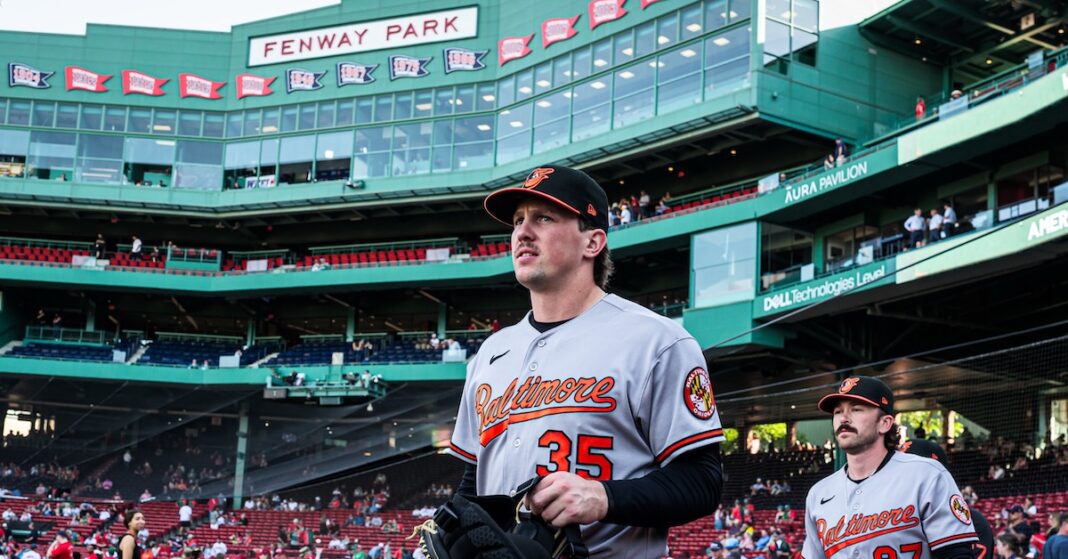

With apologies to Tarik Skubal and the Dodgers, for my money the most eye-catching deal ahead of Monday’s trade deadline was the Red Sox acquiring Adley Rutschman in a six-player blockbuster with the Orioles. Not only did a switch-hitting All-Star catcher move from one Wild Card contender to another, but he did so within the same division — and he’s more than a rental, with one more year of arbitration eligibility before he reaches free agency. Though he’s currently on the injured list due to inflammation in his left wrist, Rutschman is reportedly nearing a rehab assignment, and once he returns, he should provide a substantial upgrade for a team whose catchers landed on my Replacement-Level Killers list a few weeks ago.
Rustchman wasn’t the only prominent catcher on the move to a contender on Monday, as the Marlins traded Liam Hicks to the Rays, but he’s a part-time backstop whose hitting makes him a useful DH and first base option as well. While the concurrence of his being dealt illustrates that trading for a catcher on the fly in the midst of a playoff race isn’t unheard of, such moves do stand out. They’re not to be undertaken lightly because of the weighty responsibility that falls on a catcher’s shoulders in terms of quickly having to build relationships with a new pitching staff to understand repertoires, situational preferences, and interpersonal dynamics. Odds are that those newcomers are also expected to provide more offense than the catchers they replaced, because offensive slumps often spur teams to make such changes.
The Rutschman trade also included backup Jake Rogers getting dealt for the second time within a week, first from the Tigers to the Orioles and then from Baltimore to Boston. In writing about such deals and interviewing both Red Sox newcomers, the Boston Globe’s Alex Speier touched on the rarity of such trades making the ultimate payoff:
“In baseball history, there’s been exactly one World Series game started by a catcher acquired via midseason trade by an eventual champion. That distinction belongs to old friend Christian Vázquez, who along the way navigated a four-pitcher no-hitter for the Astros in Game 4 of the 2022 World Series, three months after the Sox dealt him for Wilyer Abreu and Enmanuel Valdez.”
Even with the comparative scarcity of such moves, other catchers dealt during the Wild Card era have at least pushed their teams closer to championships. But some prominent moves along these lines were busts, while others worked on an individual level even as the newcomers’ teams succumbed to other problems, including pesky postseason opponents. What follows are some examples that stand out, in hopes that we can learn something from them. This list isn’t comprehensive, and I did limit it to catchers who were traded in June or later (sparing you a few hundred words on Mike Piazza’s 1998 odyssey). The focus here is on starters, though I included a few prominent backups for reasons that will become clear. The catchers are listed chronologically.
Jim Leyritz, 1998 (Red Sox to Padres)
Jim Leyritz never caught more than 69 games in a season, but he stayed busy due to his versatility, picking up time at first and third base, in the outfield corners, and as a pinch-hitter. Who can forget his game-tying three-run pinch-hit homer off Mark Wohlers in Game 4 of the 1996 World Series, which turned the tide towards the Yankees? On the heels of that career highlight, Leyritz was traded four times in a span of just over 18 months. The third trade sent him from the Rangers to the Red Sox in November 1997; he caught just one game in Boston while serving as the short half of a DH platoon, then on June 20 was traded to the Padres as part of a five-player deal. San Diego had lost Greg Myers, the backup to starter Carlos Hernandez, to a fractured left hand. Leyritz made just 20 regular season starts behind the plate for San Diego, plus another 17 at first base and one at third, and came off the bench another 24 times, hitting .266/.384/.420 (125 wRC+). The Padres, 48-25 at the time of the trade, cruised to an NL West title at 98-64, then beat the Astros and Braves in the playoffs to win their second pennant in franchise history. Leyritz played in 13 of the team’s 14 postseason games, catching four. Two of those were in the World Series against the Yankees — the rarity of such starts is the main reason he’s included here — but he went 0-for-10 against his old team. He’d help them win the next year, after another midseason trade brought him back to the Bronx, but his days of catching in the postseason were done.
You Aren’t a FanGraphs Member
It looks like you aren’t yet a FanGraphs Member (or aren’t logged in). We aren’t mad, just disappointed.
We get it. You want to read this article. But before we let you get back to it, we’d like to point out a few of the good reasons why you should become a Member.
1. Ad Free viewing! We won’t bug you with this ad, or any other.
2. Unlimited articles! Non-Members only get to read 10 free articles a month. Members never get cut off.
3. Dark mode and Classic mode!
4. Custom player page dashboards! Choose the player cards you want, in the order you want them.
5. One-click data exports! Export our projections and leaderboards for your personal projects.
6. Remove the photos on the home page! (Honestly, this doesn’t sound so great to us, but some people wanted it, and we like to give our Members what they want.)
7. Even more Steamer projections! We have handedness, percentile, and context neutral projections available for Members only.
8. Get FanGraphs Walk-Off, a customized year end review! Find out exactly how you used FanGraphs this year, and how that compares to other Members. Don’t be a victim of FOMO.
9. A weekly mailbag column, exclusively for Members.
10. Help support FanGraphs and our entire staff! Our Members provide us with critical resources to improve the site and deliver new features!
We hope you’ll consider a Membership today, for yourself or as a gift! And we realize this has been an awfully long sales pitch, so we’ve also removed all the other ads in this article. We didn’t want to overdo it.
Charles Johnson, 2000 (Orioles to White Sox)
An All-Star catcher for the World Series-winning 1997 Marlins, Charles Johnson was dealt to the Dodgers in the Piazza blockbuster the following year, then sent to the Orioles in a three-way trade that also involved the Mets in December 1998. On July 29, 2000, in the midst of what would turn out to be his best offensive season (.304/.379/.582, 141 wRC+), the 29-year-old backstop and designated hitter Harold Baines were dealt to the White Sox for a four-player package that included catcher Brook Fordyce. Sharing catching duties with the light-hitting Mark Johnson (no relation), Johnson hit better after the trade (153 wRC+) than before it (135 wRC+), and the White Sox, who were an American League-best 63-40 at the time of the deal, maintained that distinction with a 95-67 finish. However, they were swept by the Mariners, the AL Wild Card team, in a three-game Division Series, during which Johnson went 3-for-9 without a run scored or an RBI.
Already we have an important take-home lesson in these matters. The league’s best team acquired a catcher who had already won a World Series ring and remained at the top of his game, but even with things firing on all cylinders through the rest of the regular season, the joyride ended quickly thanks to a hot postseason opponent.
Paul Lo Duca, 2004 (Dodgers to Marlins), and Brent Mayne, 2004 (Diamondbacks to Dodgers)
Just weeks after the 32-year-old Paul Lo Duca made his second consecutive All-Star team, general manager Paul DePodesta traded the popular catcher to the Marlins in a six-player deal that practically burned down the internet. Not only was Lo Duca hitting .301/.351/.444 (111 wRC+) after a subpar offensive season, but DePodesta, in his first year as GM after coming over from the Moneyball-era A’s, was widely derided for trading the heart and soul of the team, which was leading the NL West at 59-42. The three players Los Angeles acquired — Hee-Seop Choi, Brad Penny, and Juan Encarnacion — all flopped, as did the light-hitting 36-year-old Brent Mayne, whom the Dodgers acquired from the Diamondbacks in a five-player a day later to replace Lo Duca as the primary catcher. Capped by a walk-off home run by another player acquired from the Diamondbacks, Steve Finley, the Dodgers nonetheless won the NL West with a 93-69 record before losing a four-game Division Series to the Cardinals. The Marlins, again defending champions, were 52-50 at the time of the trade but just 3.5 games behind the NL East-leading Braves. Lo Duca, who relegated the light-hitting Mike Redmond to backup status, slumped to an 82 wRC+ the rest of the way as Florida finished 83-79, 13 games out of first and nine back in the Wild Card hunt.
A few years later, the Dodgers’ desire to ditch Lo Duca became easier to understand. In December 2007, his name turned up in the Mitchell Report for serving as a prominent conduit to connect players to Mets clubhouse worker and performance-enhancing drug dealer Kirk Radomski. The Dodgers were heavily implicated throughout the report, and came out looking even worse when a 2003 internal memo (which predated DePodesta) noted that the catcher “Got off the steroids… [which] Took away a lot of hard line drives,” and suggested trading him if they could get comparable value.
Ivan Rodriguez, 2008 (Tigers to Yankees) and 2009 (Astros to Rangers)
By 2008, Ivan Rodriguez was well on his way to Cooperstown after running off 10 straight All-Star appearances with the Rangers, winning an MVP award, helping the Marlins to their second championship during a one-year stopover in 2003, and catalyzing the turnaround of the Tigers from a 119-loss season in ’03 to pennant-winners in ’06. In 2008, his final year under contract with Detroit, the Tigers were just 54-52 when they traded the 36-year-old Rodriguez to the Yankees. In their first year under Joe Girardi after Joe Torre’s shocking ouster, the Yankees were 58-48 at the time of the deal, four games out of first place in the AL East and two behind the Red Sox in a crowded Wild Card race, but they had just lost Jorge Posada to season-ending surgery to repair a torn labrum.
Rodriguez, batting .295/.338/.416 (99 wRC+) at the time, slumped to a .219/.257/.323 line (48 wRC+) the rest of the way, worse even than Posada’s light-hitting backup, José Molina (51 wRC+). He apparently didn’t click with his new pitching staff either. While the Yankees finished 89-73, they fell six games short of the Wild Card spot, and missed the postseason for the first time since 1993.
After hitting free agency, Rodriguez signed a one-year deal with the Astros. His bat hardly rebounded (.249/.280/.384, 72 wRC+) and Houston slipped below .500, so on August 18, he was dealt back to the Rangers in a waiver-period deal. The Rangers were 67-50 and leading the AL Wild Card race at the time, but they fell into a 20-25 tailspin. Rodriguez supplanted Jarrod Saltalamacchia as the starting catcher, but he continued to struggle at the plate. The pitching collapsed, and even while going 87-75, the team missed a Wild Card spot by eight games and a division title by 10. A data point for “you can’t go home again,” as well as “don’t change starting catchers mid-season.”
Victor Martinez, 2009 (Cleveland to Red Sox)
The 30-year-old Victor Martinez had just made his third All-Star team when he was traded to the Red Sox for pitchers Nick Hagadone, Justin Masterson, and Bryan Price (not the manager/pitching coach) on July 31, 2009. Awkwardly enough, it was on the eve of Victor Martinez Bobblehead Night at Jacobs Field, but the offense-first backstop was in the final guaranteed year of his contract, and Cleveland was on its way to a 65-97 season. Martinez improved from a 119 wRC+ before the trade to a 138 after, finishing at .303/.381/.480 with 23 homers while sharing catching duties with a fading 37-year-old Jason Varitek and first base duties with fellow deadline addition Casey Kotchman. The Red Sox, 59-42 with the AL’s third-best record at the time of the trade, finished 95-67 and claimed the AL Wild Card, but they were swept by the Angels in the Division Series. As expected, the team picked up Martinez’s $7.7 million club option, and he continued to rake for most of the next half-decade while gradually shedding the tools of ignorance.
Bengie Molina, 2010 (Giants to Rangers)
In the final campaign of his 13-year major league career, Bengie Molina spent the first half of the season as he had the previous three, serving as the starting catcher for the Giants. On July 1, he was traded to the Rangers in a three-player deal so that the Giants could open the position for 23-year-old rookie Buster Posey, the fifth pick of the 2008 draft. They’d initially promoted Posey for a cup of coffee in late 2009, and the following season spent a month easing him into the lineup as their regular first baseman while giving him just three starts behind the plate. Just 40-37 and fourth in the NL West when they traded Molina, the Giants went 52-33 the rest of the way and captured the National League pennant. The Rangers, tied for the AL’s best record 47-30 at the time, slotted Molina ahead of their Taylor Teagarden/Matt Treanor tandem.
Their rest-of-season outcome wasn’t great, as Molina hit a dreadful .240/.279/.320 (54 wRC+) while the Rangers went just 43-42, but they still finished 90-72, cruising to a division title. Molina got hot in October, going a combined 10-for-30 with seven RBIs in the Division Series against the Rays and the ALCS against the Yankees, and homering in each series. The Rangers’ pennant guaranteed him a World Series ring with either outcome. Molina started four of the five games in the Fall Classic — the most by any of the traded catchers here — but went just 2-for-11 as the Giants prevailed. That Posey fella went on to bigger things.
Jonathan Lucroy, 2016 (Brewers to Rangers) and 2017 (Rangers to Rockies)
Jonathan Lucroy emerged as a star at the point when pitch framing metrics gained popularity. He helped the Brewers win the NL Central in 2011, finished fourth in the MVP voting while making his first All-Star team in 2014, and from 2011–15 was by far the game’s top framer, at least by our current metrics, and the second-most valuable catcher behind Posey. Fresh off his second All-Star selection and in the final guaranteed year of his contract, he was traded to the Rangers in a five-player deal on August 1, that after exercising his no-trade clause to veto a trade to Cleveland. Texas was 62-44, six games up in the AL West, with Robinson Chirinos and Bobby Wilson splitting catching duties. With Wilson hitting the waiver wire and Chirinos moving into the backup role, Lucroy clubbed 11 homers en route to a career-high 24 as well as a .292/.355/.500 (123 wRC+) line. The Rangers finished an AL-best 95-67, but met an abrupt end as they were swept by the Blue Jays in a rematch of the previous year’s Division Series, albeit with fewer bat flips; Lucroy went 1-for-12. Cleveland went on to win the AL pennant without him before narrowly losing to the Cubs in the World Series.
The Rangers picked up Lucroy’s $5.25 million club option, but his offense and framing — which had already declined to average in 2016 — crashed, as did the team. With the Rangers just 50-53, they traded him to the Rockies for a player to be named later on July 30. Lucroy improved from a 61 wRC+ with Texas to a 112 with Colorado while supplanting the unproductive Tony Wolters/Tom Murphy tandem. Nonetheless, the Rockies, 59-45 at the time of the trade, skidded to 28-30 the rest of the way. They still secured a Wild Card berth, but lost the Wild Card Game to the Diamondbacks.
Wilson Ramos, 2018 (Rays to Phillies)
Wilson Ramos made the AL All-Star team on the strength of a .297/.346/.488 (131 wRC+) first half, but strained his left hamstring in the weekend before the All-Star Game, and remained sidelined when the Rays (53-53) sent him to the Phillies (58-48, leading the NL East) for a player to be named later on July 31. Upon being activated on August 15, Ramos recorded back-to-back three-hit games and batted a sizzling .337/.396/.483 (135 wRC+) while sharing catching duties with Jorge Alfaro. Even so, the Phillies went just 22-34, with their staff torched for a 5.49 ERA during an 8-20 September. Not only did they miss the playoffs, they finished 80-82. While Ramos’ rapport with Mets pitchers, and particularly Noah Syndergaard, would come under scrutiny the following season, the itinerant backstop was not particularly implicated in the Phillies’ collapse.
Martín Maldonado, 2018 (Angels to Astros) and 2019 (Royals to Cubs to Astros)
The Astros loved Martín Maldonado enough to trade for him in back-to-back seasons. A commanding presence behind the plate, he was a strong enough receiver in his prime to be valuable even while posting a wRC+ in the 70s. He was hitting a pretty typical .223/.284/.332 (70 wRC+) for the Angels in 2018 when the Astros acquired him in exchange for prospect Patrick Sandoval and international bonus pool money on July 26. The defending champions were 67-37 at the time, leading the AL West by five games, but starter Brian McCann had just undergone season-ending knee surgery, and backup Max Stassi was in his first full season. Maldonado hit .231/.257/.398 (77 wRC+) the rest of the way while starting 34 of the team’s final 58 games, and the Astros finished 103-59. Maldonado homered off Cleveland’s Cody Allen in his postseason debut, but went just 2-for-19 while starting six of eight playoff games before the Red Sox bounced the Astros in the ALCS.
With McCann and Maldonado both hitting free agency, Houston brought in Chirinos to start. He was effective, but Stassi struggled as his understudy before being traded to the Angels on July 31. Maldonado spent the first half of the season as the Royals’ regular catcher despite not signing until March 11, after Kansas City lost Salvador Perez to Tommy John surgery. On July 15, Maldonado was dealt to the Cubs, and split time with Victor Caratini while Willson Contreras was sidelined by a foot injury. On July 31, the Astros reacquired him in exchange for Tony Kemp. At 69-39, they were again running away with the AL West, and started Maldonado in only 24 of 53 regular season games, but he hit a robust .202/.316/.464; his 107 wRC+ in those 98 plate appearances was the only stint in a 16-year career where he was at least league-average with the stick. He started six of the team’s 18 postseason games, including World Series Games 1 and 5, hitting .300/.333/.500. The Astros lost to the Nationals in a seven-game thriller, but Maldonado didn’t play in either of the final two games.
Yan Gomes, 2021 (Nationals to A’s)
A solid defender whose offensive contributions could fluctuate dramatically, Yan Gomes was in the midst of a strong season at the plate (.271/.323/.454, 105 wRC+) when the struggling Nationals traded him to the A’s in a five-player deal on July 30. The A’s were 58-46 at the time, 5.5 games behind the division-leading Astros but firmly positioned as the second AL Wild Card spot. They were riding starting catcher Sean Murphy rather hard, as he’d started 78 of the team’s first 106 games, and had struggled in July. Though Gomes homered in his A’s debut, he slumped to a more typical .221/.264/.366 (75 wRC+) performance after the trade while starting 30 of Oakland’s 58 games behind the plate. The A’s went 15-15 in those games, and 28-30 after the trade while allowing 4.72 runs per game, bad enough that they ended up missing a Wild Card berth by six games.
Christian Vázquez, 2022 (Red Sox to Astros)
Another defense-first backstop whose offense had some drastic ups and downs, Vázquez was hitting a comparatively robust .282/.327/.432 (110 wRC+) as a 31-year-old pending free agent when the scuffling Red Sox traded him to the Astros on August 1. The Astros, 67-36 at the time, were running away with the AL West but their catchers had landed on my Replacement-Level Killers list, as the 35-year-old Maldonado wasn’t hitting, backup Jason Castro was sidelined by knee inflammation, and prospect Korey Lee was deemed not ready. Vázquez merely slotted in as the backup behind Maldonado, starting only 23 of the team’s 59 games post-trade and hitting a meager .250/.278/.308 (68 wRC+). Nonetheless, the team went 16-7 in his regular season starts en route to a 106-56 record, and won both of his postseason starts behind the plate, including Game 4 of the World Series against the Phillies, the aforementioned combined no-hitter by Cristian Javier and three relievers, just the second no-hitter in World Series history. With Maldonado starting five of the six games, Houston won the series.
In all, in 31 years of Wild Card-era baseball prior to this season, I counted over two dozen trades of catchers who made at least 200 plate appearances in a season and played at least one postseason game. A few other deals could have been included here, but they were largely job shares on teams bumped out of the first round, and featured less-prominent players. The above trades fit the bill best, and even with so many stars on the move, only Molina and three backups (Leyritz, Maldonado, and Vázquez) even caught World Series games in the seasons they were traded. While in-season tinkering with a pitching staff’s chemistry shouldn’t be undertaken lightly, pinning every outcome short of a championship on catcher-related moves is a stretch. So many other factors come into play, particularly as the postseason tournament expands. It’s just tough to catch lightning in a bottle.