


The appeal of face-to-face play
In an article for The Times titled “Chess at Simpson’s in the Strand – where better to play?”, published on 3 May 2026, Harry Wallop uses the reopening of Simpson’s in the Strand as a starting point for a broader look at chess’ renewed popularity, especially as an in-person, social pursuit.
Simpson’s, one of London’s best-known old restaurants, has reopened under the restaurateur Jeremy King after a five-year closure. King, associated with venues such as The Ivy, The Wolseley, Arlington and The Park, has restored the Strand institution with close attention to its history. Among the details noted by Wallop are the brass chess pieces placed above table lamps – a subtle reference to the building’s original purpose. When Simpson’s opened in 1828, it was not primarily a restaurant, but a coffee house for chess players.
Bent Larsen (1935–2010) was the greatest chess player in Danish history, and for a time, the second-strongest player in the Western world behind Bobby Fischer. Between 1954 and 1971, he won the Danish Championship six times, and achieved numerous international tournament victories throughout his career.
Free video sample: Introduction to Bent Larsen by Peter Heine Nielsen
Free video sample: Introduction to the Opening Section
That history is central to King’s plans for the revived venue. He tells Wallop that in the nineteenth century chess could draw a level of public interest comparable, in his view, to modern football, with runners carrying news of results – and even individual moves – between clubs. Simpson’s later became equally famous for its traditional British food, particularly roast meats served from carving trolleys. King notes that these trolleys originally allowed players to continue their games while being served, without leaving the board.
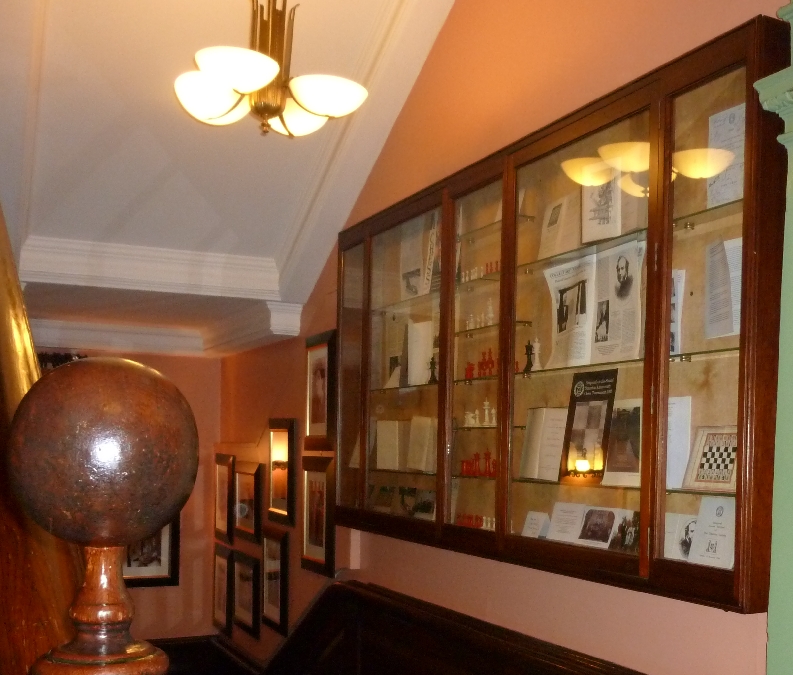
Chess memorabilia showcased at the Grand Divan (photographed in 2012) | Photo: Lovuschka via Wikimedia Commons
The revived Simpson’s will not place chess in the main dining room, the Grand Divan, but King intends to bring the game back upstairs, in the Assembly Room and bar. The drinks list also nods to the theme, with cocktails including a Gambit and a Checkmate. King describes himself as “perfectly chess capable”, but emphasises the appeal of physical pieces and face-to-face play in a screen-heavy age. For him, chess can provide a form of quiet social interaction, even when the players themselves say little.
Wallop then places Simpson’s in the context of a wider chess boom, noting that the revival is not only online. He reports that physical chess sets are selling well, while the piece also surveys the growth of social chess in Britain. Wallop cites Birmingham’s Chesscafé, founded by a student, and Knight Club in east London, which combines chess with a nightclub atmosphere and attracts a young crowd.
Chess has become attractive not only as a competitive game, but also as a way to disconnect from constant digital distraction. Wallop’s piece presents the return of chess to Simpson’s not as a nostalgic curiosity, but as part of a broader shift towards games, conversation and shared physical spaces.
Read the full article…
The Gambit Chess Rooms in London, during the lunch hour (1946) | Video: British Pathé