


Taking a Repertoire One Step Further
Grandmaster Elisabeth Pähtz is a familiar face in the ChessBase studio. For decades, she was Germany’s leading female chess player, and in 2022 she earned the grandmaster title. She has already released a number of courses, with a clear focus on the various lines of the London System.
The London System according to Pähtz
Over the years, GM Elisabeth Pähtz has not only analysed and presented the modern move order with 2.Bf4 and 3.e3, but also the Jobava London System with Bf4 and Nc3 instead of Nf3, as well as the Neo-London System featuring an early c2-c3. In her latest course, she expands her repertoire with the move order 2.Bf4 and 3.Nf3, which is essentially the classical London setup and can also be reached flexibly via 2.Nf3 and 3.Bf4.
The Jobava London System is a minor form of the London System. White tries to play Lf4 quickly followed by Nc3.
Thus, this repertoire is more than just a standalone course. Rather, it is an extension of a concept that has been developed over many years, aiming for maximum flexibility while demonstrating why the London System has emerged from the shadows of a sideline into one of the most popular openings in chess. The idea is not to follow a fixed setup, but to use subtle move orders from the very beginning to probe Black’s preferred systems and responses.
With the early move Bf4, the bishop occupies its active square on f4, but at the same time leaves the b2-pawn more vulnerable. This is less critical in the Neo-London move order, as White can always bring the queen to its defence (unless the pawn is deliberately sacrificed). This weakness on b2 sometimes allows Black to play an early …c5, immediately putting pressure on both the d4- and b2-squares.
The Neo-London System offers many new, creative possibilities to present your opponents with serious problems in the early stages of the game.
Structure and Didactic Approach
The course follows a fairly straightforward structure. It begins by focusing on the main London System positions, with the material divided into the most popular lines:
- Early …c5 with …Qb6 (attacking the b2-pawn)
- Caro-Kann London with an early …cxd4
- The …Nh5 plan, chasing the bishop on f4
- The quieter variations with 2…Bf5 or 2…e6 are also covered, as well as options for transposing into the Queen’s Gambit.
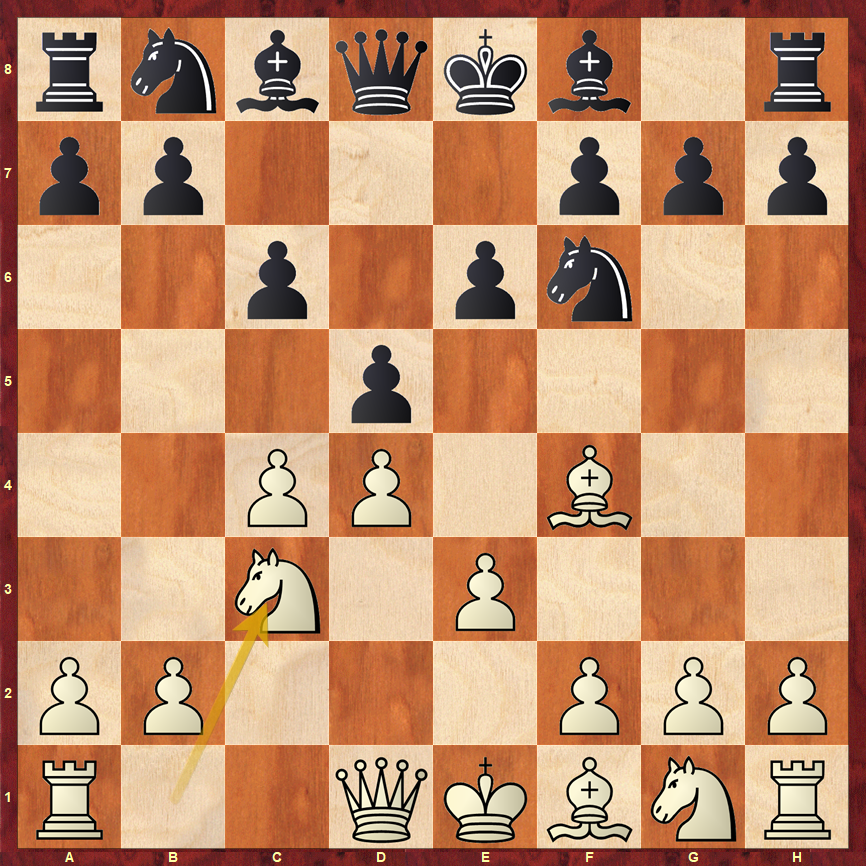
Transposition into the Queen’s Gambit: 1.d4 d5 2.Bf4 Nf6 3.e3 c6 4.c4 e6 5.Nc3:
One major advantage over Pähtz’s earlier publications is, in my view, the chapter on the differences from and references to the Neo-London System. It sends a clear message: this is not intended to be a repertoire that stands on its own. Rather, it brings together her previous courses and expands them into a repertoire suitable for tournament play. This chapter in particular gives the user an overview of the possibilities offered by the different move orders.
In a total of 6 chapters, we look at the following aspects: the right decision based on tactical factors, decisions in exchanges and moves, complex and psychological decisions in longer games and in defence.
Variation Selection
For London System players, one of the key questions is always how a course deals with the main lines. Here, Pähtz opts for the setup with 5.Nbd2, treating it as the main move order. Against the increasingly popular 5…Nh5, she recommends the critical 6.dxc5, leading to dynamic positions with chances for both sides. She presents a number of interesting ideas that are not mentioned in Christian Bauer’s treatment of the 5.Nbd2 Nh5 line, but which Stockfish 18 now ranks among its top choices. This demonstrates that the course is by no means recycling old variations, but instead develops the opening further and offers ideas that are fully viable in tournament practice.
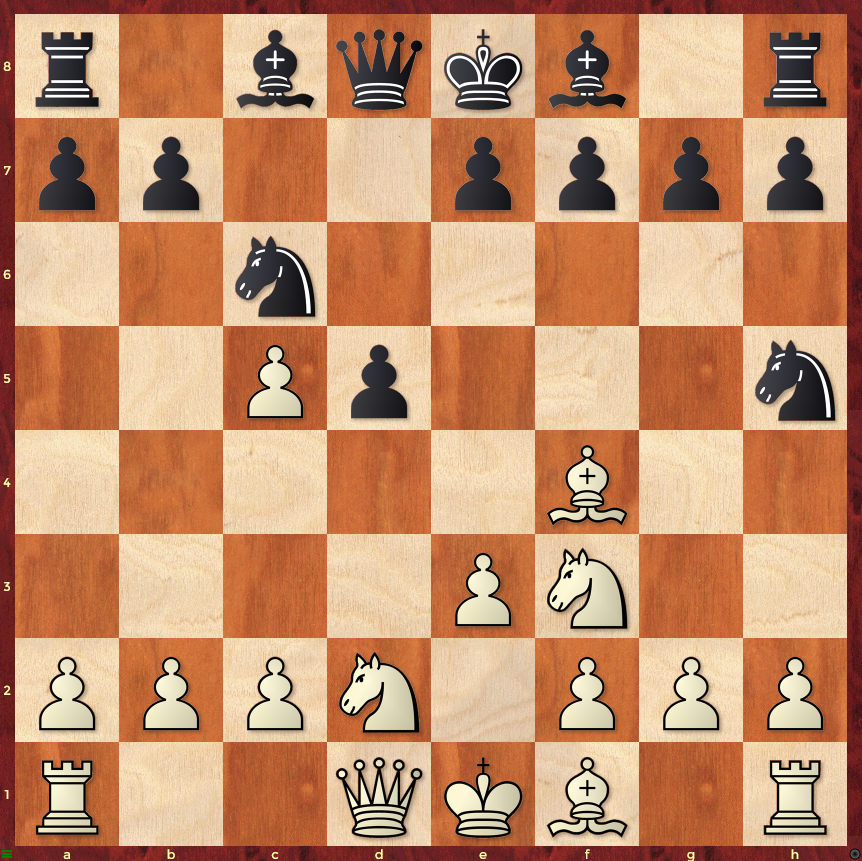
Critical line: 1.d4 d5 2.Bf4 Nf6 3.e3 c5 4.Nf3 Nc6 5.Nbd2 Nh5 6.dxc5:
In particular, the sheer scope of this overview makes the course appealing to an audience well beyond the average club player, as many of the ideas have not yet been covered in the existing opening literature from White’s perspective.
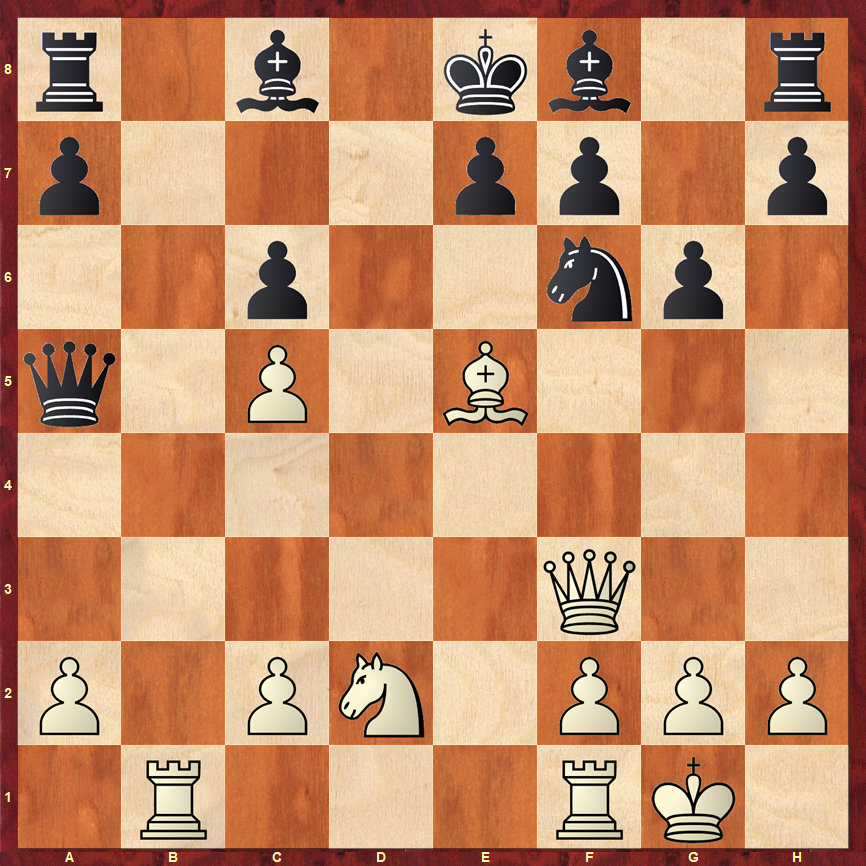
The main line with 5.Nbd2 Qb6 also demonstrates the depth of the analysis, although I found some references missing, as the theory has developed considerably in recent years. For example, in 2020 Sam Shankland had already examined this line for Black and recommended the critical 13…Nd5, which is not covered in the course. Here, the viewer will need to do some additional work to avoid being caught by surprise.
Line after 5.Nbd2 Qb6 6.dxc5 Qxb2 7.Rb1 Qc3 8.Bb5 g6 9.e4 dxe4!? 10.Be5 Qa5 11.0-0 exf3 12.Bxc6+ bxc6 13.Qf3:
Additional Material
In addition to the chapter already mentioned on the different move orders within the various London System repertoires, the course also includes a dedicated chapter of exercises. It presents 15 carefully selected positions designed to test the viewer’s understanding. This is always a welcome feature, as it reinforces typical moments where mistakes can easily be made.
The course also includes the repertoire training app for ChessBase, allowing users to practise the selected repertoire lines. You can either display the variations, work through them using the replay training mode, or start a repertoire drill to make memorisation easier.
Target Audience
As this repertoire is based on the classical move orders, I would define its target audience more broadly than that of Pähtz’s previous courses. Anyone looking for an introduction to the London System will find an excellent foundation on which to build a repertoire. Players who already have a basic knowledge of the opening will benefit from a theoretical update that keeps them in touch with the latest developments.
The course is therefore well suited to tournament and league play from a playing strength of around 1600 onwards, even if many of the critical lines analysed in such depth are unlikely to occur very often in practice. Nevertheless, it provides a solid foundation on which players can continue to build their repertoire.
Conclusion
A valuable contribution to the literature on the London System. This repertoire contains virtually everything needed to get started with the London System, while also offering a wealth of analysis and material for experienced London players. The only drawback is that some relevant references are omitted, requiring the user to carry out a certain amount of additional research.
Overall evaluation: ★★★★ 4/5
Positive:
✔ Very comprehensive content
✔ Logical structure
✔ Highly up-to-date opening survey
✔ Exercises and repertoire training
Negative:
– Some material requires additional work by the user
About the author:
 Elisabeth Pähtz (born 1985) has been Germany’s leading female chess player for many years. She has represented the German national team since 1998, earned the WGM title in 2001, became an IM in 2004 and a GM in 2022. In 2002, she won her first World Championship title in the Girls Under-18 category, followed three years later by the Girls Under-20 World Championship. In 2017, she won the bronze medal at the World Rapid Championship, and in 2018 she became European Rapid Champion and European Blitz Championship runner-up.
More products by the author…
–> MORE REVIEWS <–
The continuous stream of new ideas in the Sicilian makes 1..c5 the most popular answer to 1.e4. On this DVD I do give an introduction to the most important Sicilian systems.