
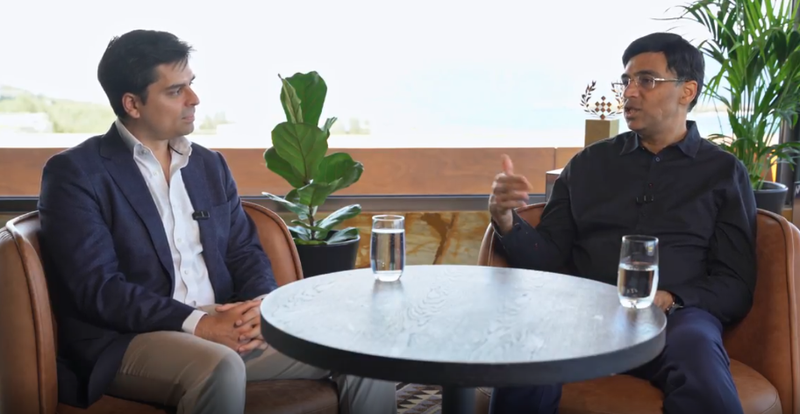

The following are edited excerpts from the full 54-minute interview, which you can watch in its entirety on our YouTube channel:
https://www.youtube.com/watch?v=yvsKQa18VwY
Patronymic “Vishy” vs Given Name “Anand”
TW: Everyone in the chess world knows you as “Vishy”, which comes from your patronymic. Has it ever been frustrating for you that you’re not more widely known as Anand, your given name?
VA: Not at all, I got used to it very quickly. It started around ’82 or ’83 when I began competing in national competitions. Tamil Nadu is different from up North—In the North, they use the patronymic, whereas somehow here we swap. For instance, I am actually Anand Viswanathan, not Viswanathan Anand. I played in Delhi once, and they referred to me as Viswanathan Anand and my mother as Sushila Anand—but she’s very much Sushila Viswanathan.
Then I played in Frunze once in ’87, and there was a small group of us including Danny King and Tibor Károlyi playing this tournament. Maia Chiburdanidze was there, and at some point she said “I’m just going to call you Vishy, it’s much simpler than Viswanathan”. So that’s where Vishy came in, and frankly Vishy Anand sounds better than Anand Vishy—or maybe I’m just used to it. When my parents came for my first Candidates in Brussels—the quarterfinals against Karpov—my father went to get his name badge and they said, “Well, what should we call you?” and he finally settled for “Vishy Sr”. Long story short, I got used to that, it’s absolutely fine.
Credit: Lichess
Support by Anand’s Mother
TW: Would you credit your mother as the main motivation behind your passion for chess?
VA: I doubt I would have ended up as a chess player without my mother supporting me every step of the way. In those days, if you didn’t have a family member or a friend who knew how to play chess, you couldn’t look up the rules very easily. There was no such thing as “online”, sometimes there’d be one or two libraries in the town which might have the rules, and it was quite difficult to search for. We found a chess club, but obviously I was a bit young for a chess person. So, my mother came along with me to make me a member of the club, but also to make sure that I’d be safe and have no bad habits and all that. She accompanied me, found a man who said he would keep an eye on me and so on.
In the Philippines [Anand’s family moved to Manila in 1978] you can see the level of engagement. My mother was watching the chess program [Filipino TV show Chess Today] on my behalf. My mother would watch the games, writing down the moves and the analysis as the host described them, and when I came back we’d play through the game with the analysis. Now it’s difficult to even imagine this world, but in those days if there was a game played in Moscow or Prague or wherever, this is the only way we would find out. Otherwise, it could be months before a bulletin arrived, and those bulletins were scattered all over the place.
Mostly what I remember is that she would accompany me everywhere; she’d take me to all the tournaments herself. In Manila I remember we’d get onto those jeepneys to go to the tournament, play, and then come back home. It was the same in India as well. Whenever I played outside of Chennai—or Madras, as it was called then—she accompanied me to tournaments until I was about 16 or so. From the age of 13, I slowly started traveling alone from time to time, but until I was 16, she was usually there.
 19-year-old Anand, Wijk aan Zee 1989 | Credit: Dutch National Archives, CC0
What I credit my mother and my father for is that if they had any misgivings or apprehensions about chess as a career—which must have been a real thought for them, especially 40 years ago in India—they never once let on. I think that was a huge support. If you think your parents are not thrilled or not fully behind you, that would have been a blow. Instead, I went there thinking my parents were very proud that I was playing chess, and that made a huge difference. My mother learnt the rules and played with her brothers, but I don’t think she ever got to the stage of studying openings. She had to first raise my elder brother and sister, then raise me and she was just busy with that. She never really found the time to play much.
Evolution of the Game
TW: Throughout your career, you’ve played players like Tal, Spassky, Karpov, Korchnoi, Kramnik, Kasparov, Carlsen, Aronian, Caruana, Gukesh, Firouzja, even Faustino Oro. How has chess evolved since your early years?
VA: The big difference was that when I was growing up, you were scared by nationality. Whenever I was sitting across a player from the former Soviet Union, I automatically thought, “He is better prepared than me. He knows more than me about this, and what am I going to do?” A lot of it is in your head because it doesn’t work like that, but you have to experience it and be on the other side of it before you realise, “Hey, this is a myth.” Also, if a group of people specialized in some opening, they would retain that extra knowledge or skill in that area; it wasn’t easy to catch up.
What engines have done is they’ve flattened all these things. Now you can take an opening you’re totally unfamiliar with, and if you just go with the engine suggestions, you’re 60% of the way. You probably lack a lot of the details and the finesses, but you’ve got the best idea. And once you work out that, you can use that and then work out the rest.
Back in the day, I think Sosonko once described Geller as saying, “Oh, I could learn a new opening in about six months.” And that’s strange today because now I think you can learn a new thing in six hours, or however much time you want, everything is depth. You can learn it very quickly, but then beyond knowing the moves, you want to just feel the subtleties and nuances. But I think two hours is doable.
Playing Kasparov in 1995
TW: You encountered Kasparov in 1995 and had a very interesting match where you had 8 draws, then you won the 9th one, but unfortunately didn’t do so well in the next few games. Do you think part of that was psychological or intimidation from playing Kasparov?
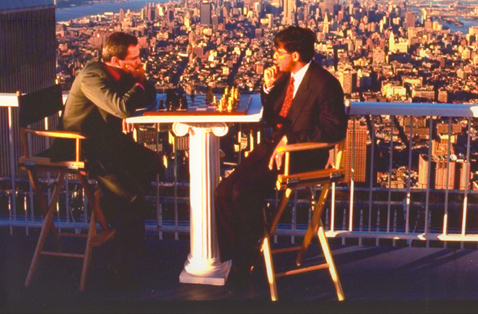 1995 PCA World Championship at the World Trade Center | Credit: Copyright 2007, S.M.S.I., Inc. – Owen Williams, The Kasparov Agency, CC BY-SA 3.0
VA: It’s possible. It’s also possible it was the gravity of the situation. Plus, I have to admit, I didn’t expect the Dragon. And though I was dealing with it in the right way—which was to play very solidly in the first game and just probe a little bit—I don’t know why I got excited by that silly tactic. Because even in my version of it, I’m not much better; I think he has enough compensation. But in his version of it, I’ve just blundered two pawns and I lost the 11th [game]. Once you do that, then you’re in a kind of breakdown phase where you’re no longer in control of yourself and you don’t know when you’re going to stop.
https://lichess.org/study/CVmVmWrm/WxfnCdF4
So that was unfortunate. I mean there are multiple causes. He was a stronger player, and so the chances are more random things will favor him rather than me. But by this time, I had gotten used to being with Soviet players. I’d stopped seeing them as mythological figures and more as humans with the same foibles as everyone else.
But remember, this was a time when it wasn’t just about chess. Every country you visited had an alien language. You just didn’t know your way. You had one guidebook and you tried to think. When you spoke to people, you had almost no common experiences. Maybe a few movies were common knowledge, but otherwise you had nothing in common with a person from another country. Whereas now, you might have 20 series or 30 books in common. Again, compare how you would speak a language then and how you speak a language now, and you get a sense of how easy it was to learn chess then and how to learn chess now.
But yes, I think the effect of being in a match with high stakes and then suddenly having a disaster—it’s about how quickly you’re able to right the ship and get back your balance. Those sorts of things I learned slowly. The next one didn’t go well, then against Shirov in 2000 I finally got the world title, and then in the second wave in Mexico [2007 World Championship Tournament] as well.
Becoming the Undisputed World Champion
TW: 2007 was the first time you became the undisputed world champion. Do you remember what you felt at that moment; was it just pure joy?
VA: I think I was even happier when I saved it against Grischuk before the last round, because the last round felt like a formality. I thought with the White pieces and the Marshall, I should be able to nail the draw. But you know, if Leko had come and played the Najdorf, then I would have thought, “Okay, he’s sending me a sign that he’s not letting me off with a draw and he wants a fight.” Then how do I proceed? I had thought of various scenarios, but once I saw the Marshall, I knew he was basically saying, “Look, if you want to finish it, I’m not going to stop you,” which I gratefully did.
I was very happy, but you get caught up very quickly. I knew there’d be a press conference a little bit later, and I knew they would immediately ask me, “Are you going to play the match with Kramnik?” I found that annoying because I thought, “Well, you haven’t even mentioned the current title and you’re already saying what will I do next year?”
But at a deeper level, there was a certain satisfaction in thinking I don’t have to talk to another idiot about which is the more important title. Now we have closed that part of my life. In 2001, what I hated was random people coming to me and saying, “Yeah, very well done, but you know it’s not the real title.” Well I didn’t even ask you! In 2007, I knew I was closing that chapter and that was good. Not completely—I knew the match was still coming, that was the new “but that’s not the real title”—but I was happy to play the match and I thought, “Well, I’m ticking the boxes as they come along and that’s fine.”
 Credit: Georgios Souleidis, CC BY 2.0
In Bonn [2008 World Championship Match], finally I knew all the discussion about legitimacy was over. I could dispense with the questions of “is this the unified title?” or “which is the better title?” and finally finish with the “but you didn’t win it in a match” argument. The match itself was my best match ever; I’m happy that I got the best match ever in the first one. Then Topalov was harder, and Gelfand was much harder. The fact that I got this match out of the way, and that too against Vladdy [Kramnik], it cleared a lot of things up.
But satisfaction and joy are different things and they’re not always in sync. I was joyful a few days later. Then I think it gets to a period where you are happy for a year knowing that you’re World Champion, but the intensity isn’t there. There’s a brief moment—maybe even those last eight or nine moves against Grischuk at the end of that rook ending where I know I’m going to make a draw by going to f1—I was happier inside the game than outside. Once we signed the scoresheets and I could get up, I knew I’d look at my wife and she’d say, “Oh my god, what did you put us through?”
https://lichess.org/study/CVmVmWrm/pO23SA63#142
The happiness was intense before the end. It was the same thing when I realised I was winning against Shirov in 2000. There’s that great feeling, and then when you haul it in, you feel good. But then five minutes later, there are autographs and this and that; you’re in the maelstrom and you don’t have time to settle down. By the time you get to the evening, you don’t really know where you are. I had read this article by Sosonko I think or maybe it was Jan Timman, where he said that when Max Euwe won the title, he wrote, “I’m supposed to be happy now.” Like he was also not sure where this happiness was. It’s there for sure, but you never know when you’ll get it.
Gukesh’s Legitimacy as World Champion
TW: Do you see some parallels between that and what Gukesh is going through, where there are some people casting doubt on the legitimacy of his title?
 Credit: Eteri Kublashvili / FIDE
VA: I think what you can learn is to focus on what you can do. First of all, having been through something similar, I would say just ignore it. And if you are unable to ignore it—if at some level it bugs you—accept that that’s normal. Nobody promised you… What’s that song, nobody promised you something. Nobody promised you perfect happiness.
Even as World Champion, your life isn’t supposed to be perfect; nobody owes you perfection or a smooth, wonderful everything. It’s going to be rough. Everyone will look at you differently, and everyone covets your title secretly. I think you will not appreciate the World Championship until you lose it. Then, when you don’t have it, you’ll suddenly think, “Did I really complain about these things? Because my God, it would be nice to have it back.”
So for him, I would say it comes with the territory. Ignore them. Let the criticism go. Some of it is legitimate, if your performance has dropped. Plus, if fans buy the tickets, they have the right to say whatever they want, whether it’s just or not. You know, lock yourself in a room and just ignore it. Focus on doing a good job at some tournament. If it’s not this one, then the next one. Work towards something. Nothing answers every doubt expressed about you like a good result. I think that’s got to be the attitude.
Sympathy With Carlsen for Not Defending
TW: Having defended the title many times, did you feel this pressure, and do you have some sympathy for Carlsen who decided to relinquish the title?
 Linares 2007 | Credit: Óscar Javier García Baudet, CC BY 3.0
VA: I knew that after five titles—I mean after my fifth against Gelfand—even for that Gelfand match, I kind of dragged myself into it. I had the feeling FIDE was giving me a world championship match almost every year and it was getting tedious. I’d been struggling with my chess for a while, and I thought, “This one I scraped through.” I think even in the end, when I lost, I came to terms with the fact that, look, at a sporting level, I deserved to lose. Whatever else you say, at that level it’s clear, and you have to treat chess as a demanding occupation.
As for Magnus himself, I can see his point of view very easily. The way I see those matches now is that, at least I had them. I had three matches; there were players who were stuck for many years without a match because there was nothing happening. I had my three matches, they were all well-organized matches, and then I had my fourth match which I lost. It would have been nicer if the match with Carlsen, instead of being one year afterward, had been a bit later, but you don’t get the right to choose. It’s the pinnacle sporting event of your sport, you just have to go with the flow. You have to accept that if it comes all at once, it comes all at once. Right now, I’d rather have had it all at once than not at all. I can see myself back in those matches, and I miss them and all that.
I think after five titles, Carlsen was ready to walk away. He said, “I really don’t need to play these things,” so I could understand the sense of just moving on. Maybe in another two matches, I would have also just walked away. I don’t know, because it was already getting hard to drag myself there. Even with your team, you feel it slowly. By 2012, many members of my team said, “Okay, we can’t take this anymore. It’s year-after-year work. It’s great we’ve got this far, but we’re probably moving along.”
 Wijk aan Zee 2018 | Credit: Frans Peeters, CC BY-NC-ND 2.0
It would have been difficult to play match after match, but at the same time, you don’t get to choose. I played against Carlsen; I was not happy that it happened in Chennai, and I was not happy it happened right away. But I hadn’t lost my connection with reality to think that I was entitled to choose those things. I think Carlsen understood: “I can walk away, that gives me all the power in the world, but I’m walking away from this.” Next time there will be rules where you have to qualify again, or I’ll play in competitions where those things aren’t part of the format. So, I could certainly understand the desire to walk away.
Conclusion
TW: You’re up there as one of the greatest of all time, and have now gone very successfully into mentoring with WACA. Do you feel that there’s still more that you want to give to the chess world, or do you want to have your coffee days in Chennai with your newspaper and afternoon naps?
VA: Ideally both. Ideally, I will have a very relaxed lifestyle—coffee and especially the naps. But you’d also like to continue working and I understand it’s quite early to retire. At the same time, I’ve also clearly questioned whether playing non-stop is the only way of not retiring. I tried to find a way around that.
You’d like what you do to produce positive effects, not only for you but for others. But I’ll leave it there, I don’t think too much of the results of what will happen. I’m very happy if some of my work helps Indian chess even more, but sometimes what you’re thinking of is also: How do I stay productive? How do I stay engaged with something that gets me waking up in the morning with enthusiasm?
And that’s it.
TW: Vishy Anand, thank you so much for your time, your patience and the wonderful insights and answers. Thank you so much.
Watch the full version of this interview on YouTube.